YouTube comment reply rate: how to measure it, what is good
Reply rate is the share of comment threads the channel answered. How to count it from public data, what 8 channels scored, and why the buying questions matter.
A YouTube comment reply rate is the share of top-level comment threads on a channel's recent videos that got at least one reply from the channel itself. It is measurable from public data for any channel: read the newest comment threads on the newest videos through the YouTube Data API, skip the channel's own comments, and count the threads where a reply's author is the channel. Measured that way on 31 October 2026, across eight established tech channels, the rate ran from 0 percent to 100 percent, with a median of 15 percent. Five of the eight answered fewer than one comment in five. A "good" rate, by the only standard that matters to a viewer, is that your question gets an answer within a day; the channels that do that are the small ones, and the gap between small and big is the subject of this post.
I run a 105,000-subscriber DevOps channel alongside a full-time job and have answered nearly every comment on it for seven years. On 30 and 31 October I built the audience care score into the free channel analyzer: reply rate, median response time, and whether the buying questions got an answer, from a fixed comment sample. This post is the method, the numbers for eight channels including mine, the parts of the method that are weak, and what a creator can do about the rate this week. Where a number is from a sample, I say how big the sample is.
Channel, 31 October 2026
Subscribers
Threads sampled
Answered by channel
Reply rate
Median response
Buying questions answered
Audience care
Rahul Wagh (me)
105,000
14
14
100%
2.2 h
none asked
100
Tech With Lucy
278,000
32
12
38%
1.5 h
0 of 1
45
Cloud With Raj
128,000
14
5
36%
2.8 h
0 of 1
44
DevOps Directive
107,000
234
40
17%
3.2 h
1 of 4
44
Abhishek Veeramalla
676,000
110
14
13%
0.3 h
0 of 2
35
TechWorld with Nana
1,500,000
226
21
9%
7.4 h
0 of 4
34
NetworkChuck
5,450,000
496
5
1%
0.3 h
0 of 6
30
Kunal Kushwaha
926,000
35
0
0%
no replies
0 of 1
0
The sample is the newest 100 threads on each of the channel's newest 5 long videos, so "threads sampled" is also a rough measure of how many comments each channel gets per video right now. Read the last column with the middle ones: Abhishek and NetworkChuck answer within 20 minutes when they answer, and the score gives them credit for it; Kunal answered none of 35, and there is no response time to credit.
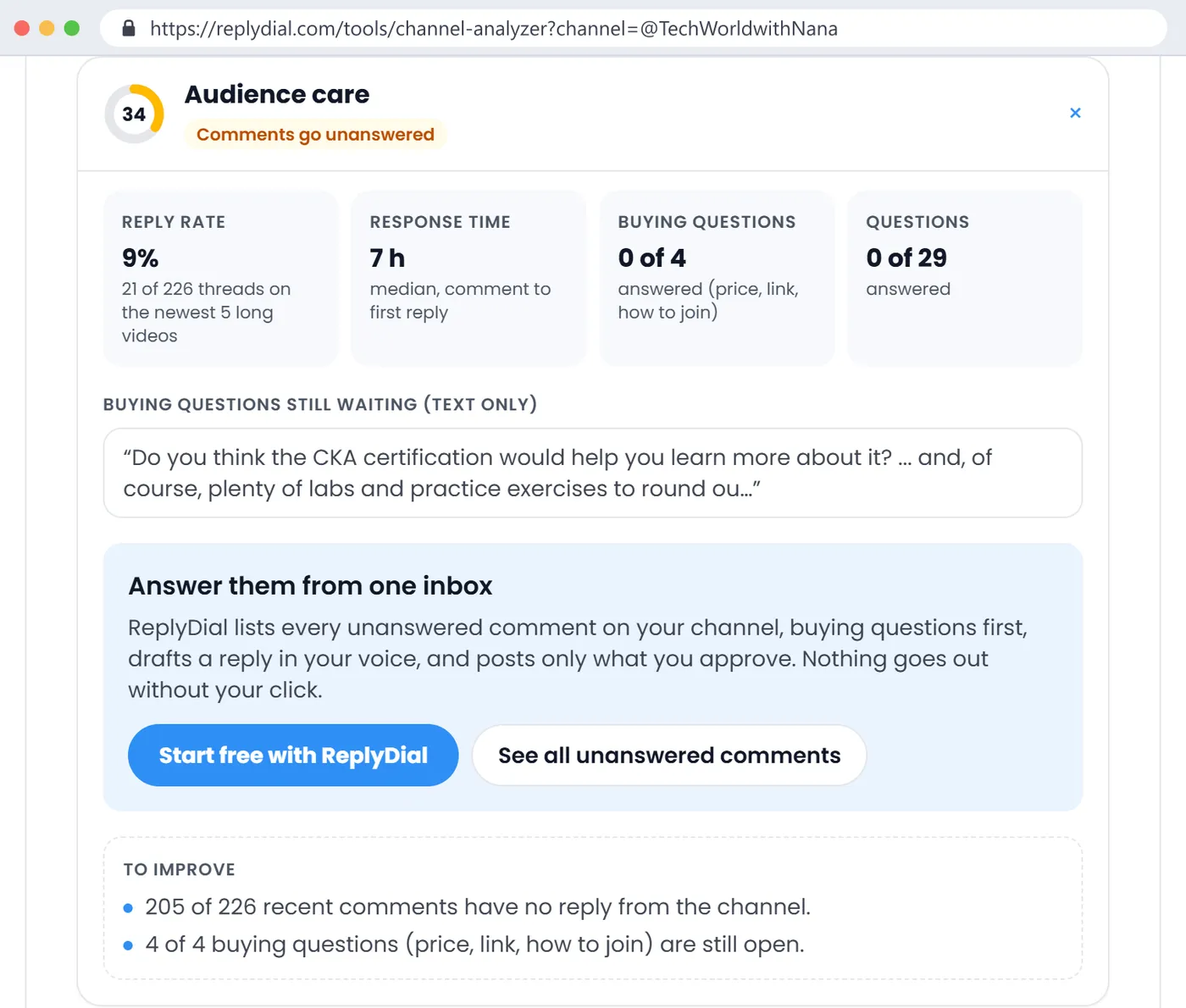
TechWorld with Nana's audience care section on 31 October 2026: reply rate 9 percent (21 of 226 threads on the newest 5 long videos), median response 7 hours, 0 of 4 buying questions and 0 of 29 questions answered, and one of the waiting buying questions quoted without a name.
How do you measure a YouTube channel's reply rate from public data?
You need four API calls per video and nothing private. The method the analyzer uses, which you can reproduce with any free API key or with the open-source youtube-comment-tools CLI:
Resolve the channel (one call) and take its channel id. Every reply the channel posts carries that id as the author, whatever the display name says.
List the newest uploads and keep the first 5 long videos (not Shorts, not live streams, not premieres still scheduled). Shorts comment sections behave differently, and a live chat is not a comment section.
For each video, read the newest 100 comment threads with their replies (commentThreads.list, part=snippet,replies, maxResults=100). One unit per video.
Drop every thread whose top-level comment was written by the channel itself. A pinned "links in the description" comment is not a viewer waiting.
A thread is answered when any of its returned replies has the channel's id as author. The reply rate is answered threads over all threads.
Response time is the hours from the viewer's comment to the channel's first reply in that thread; the report shows the median over the answered threads.
Classify each top-level comment by text rules: a buying question is an ask aimed at the creator ("do you offer", "how can I join", "where can I get", "how much") about something the creator could deliver (a course, mentorship, notes, the source code, a discount); a question is anything else with a question mark or a question starter. The report shows how many of each were answered, and quotes up to three waiting buying questions as text, with no names.
The score, 0 to 100: 40 times the reply rate, plus 30 for response time (full at a median of 24 hours or less, zero at 7 days or more, straight line between), plus 30 for the buying questions (the share answered, full when none were asked). Fewer than 10 threads in the sample and the score shows a dash. Fewer than 20 threads and no red flag is raised, however low the rate.
The 20-video version of the same count exists as the free unanswered comments checker, which reads the newest 100 threads on the newest 20 videos instead of 5, and I used it to check the sample against a bigger one. Nana's channel on 31 October: 653 of 706 threads unanswered across 20 videos (92 percent) against 205 of 226 (91 percent) in the 5-video sample. NetworkChuck: 1,650 of 1,655 (99.7 percent) against 491 of 496 (99 percent). Five videos were enough to get the rate within two points on both channels. They are not enough for the response time or the buying questions on a quiet channel, which is why my own 100 rests on 14 threads and the report says so.
What is a good reply rate on YouTube?
There is no published benchmark from YouTube, so here is what I have. Across the eight channels above, the median reply rate is 15 percent and the mean is 27, pulled up by my 100. Of the four channels under 300,000 subscribers, three answered 36 to 100 percent and one 17. The four over 600,000 answered 0 to 13 percent. On 6 October I had already scanned 33 established US creator channels for the seven-years post: 75 percent of 11,987 recent comments had no reply, 21 of the 33 channels were above 80 percent unanswered, and the most attentive channel in that set still left 16 percent open. Eight channels in October point the same way as 33 did in October's first week.
So a good rate depends on what you are asking. If you are a viewer, good means the question you asked got an answer, and from this data the honest expectation on a channel over half a million subscribers is that it will not. If you are a creator, I would put the lines where the analyzer puts its verdicts: under 30 percent on 20 or more recent threads is "comments go unanswered" and earns the red flag; 30 to 69 is "some replies"; 70 and above is "answers its viewers". If you are a brand vetting a channel for a sponsorship, the rate tells you how the comments under your sponsored video will be handled: a channel at 1 percent will not answer the viewer who asks whether your discount code still works.
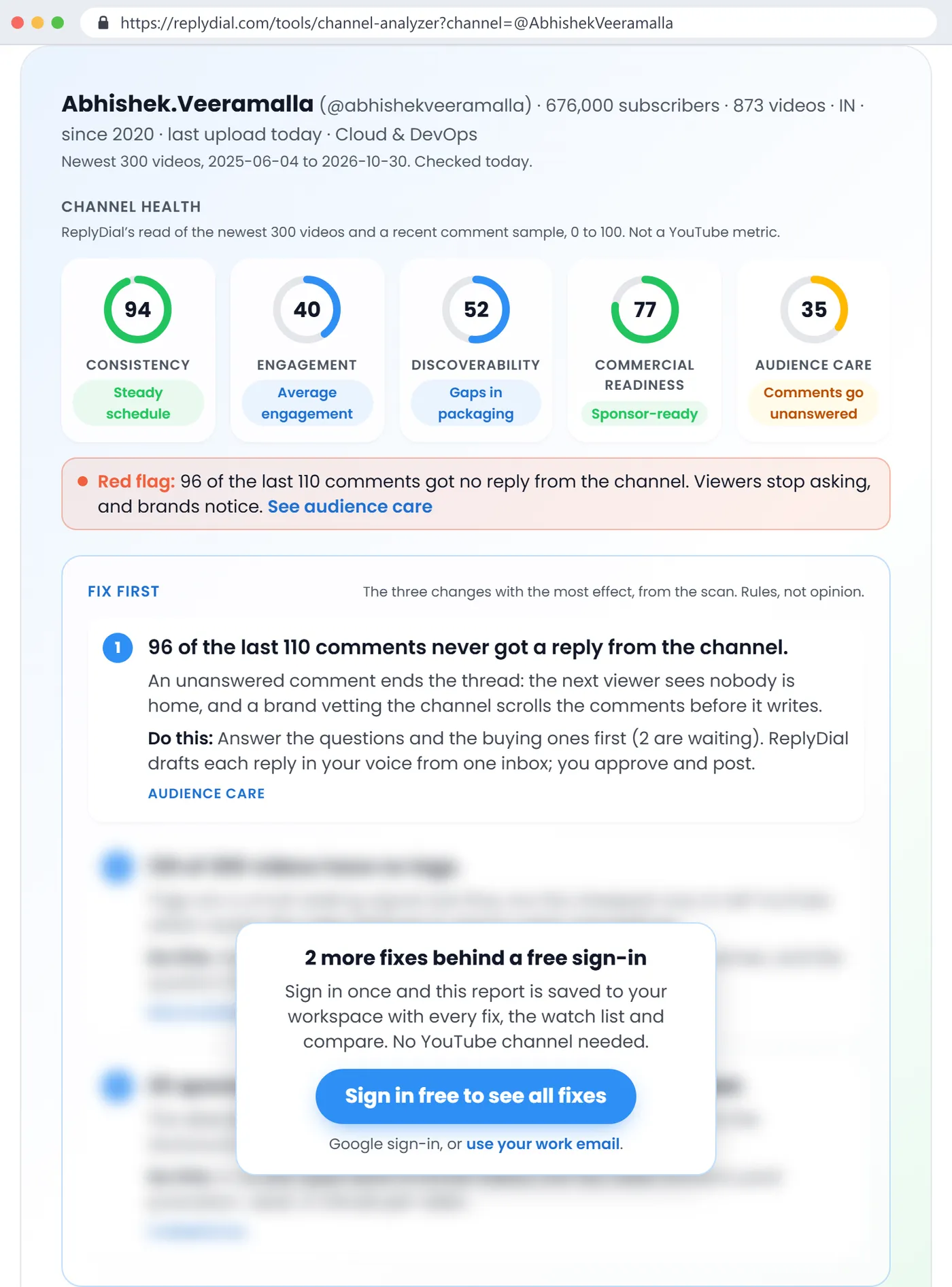
Abhishek Veeramalla's report on 31 October 2026: audience care 35 next to consistency 94, the red flag (96 of the last 110 comments unanswered), and the same fact as fix number one. A channel can publish on a perfect schedule and still leave the thread empty.
What my own numbers look like under the same rules, for scale: the 14 threads on my newest 5 long videos were all answered, median 2.2 hours, and the one question in them was answered. The bigger count from the 13 October export is the one I trust more: 1,599 threads on my five most-viewed videos, 629 replies from me, 291 of them the same day, a median wait of 1 day. My channel gets about 200 comments a week, which is the volume at which I nearly stopped, and that story is why this score exists.
Why do big channels answer so few comments?
Volume first. NetworkChuck's newest 5 long videos collected 496 threads in the sample window, and the sample is capped at 100 per video, so the real number is higher; Nana's collected 226. Answering 500 comments at my own measured pace (10 to 20 seconds for a thank-you, 1 to 3 minutes for a question) is a working day per week with no videos in it. Nobody with a 5 million subscriber channel is short of things to do with a day.
Then the first-day effect. Replies on a big channel cluster in the first hours after upload, when the creator is watching the video land. Abhishek's median response of 0.3 hours and NetworkChuck's 0.3 hours suggest exactly that: when they reply, they reply in the first hour, and after that the thread is closed. The sample reads the newest 100 threads, which on a big channel often means the newest hours, so these channels are measured at their most responsive moment and still land at 13 and 1 percent.
Then the heart. YouTube lets a creator heart a comment, and many big creators heart instead of reply. The public API does not expose hearts on other people's channels, so a heart-only creator measures as silent. I think that is the right outcome for the score (a heart does not answer "is the course still open?"), but it is a limit of the measurement and I say so on the page.
And then the thing nobody says: the comment section on a big channel is read by the creator as a mood, not as a list. You scroll, you get the temperature, you move on. The 29 questions under Nana's newest five videos with zero answers are not a sign that the creator does not care; they are a sign that nobody is turning the section into a list. That is a tooling problem and it has a tooling answer, which I will come to.
Why do the buying questions get their own 30 points?
Because they are the comments that cost money when they go cold. In Nana's sample, 4 of 226 comments were buying questions and none got an answer; one of them asked whether a certification course would help, which is a person deciding whether to spend money, in public, under a video that sells a course. NetworkChuck had 6 waiting, DevOps Directive 4 with 1 answered, Abhishek 2, Lucy, Raj and Kunal 1 each. Of 19 buying questions across the seven channels that had any, 1 got a reply.
On my own channel the rate of buying questions is about 1 percent of comments (the 13 October export put requests at 1 percent and questions at 25), so a channel with 200 comments a week gets two of these a week. The post about the comment I found four months late is about one of them. The score weights them at 30 of 100 so that a channel which answers a third of its comments, but the right third, lands in the middle band instead of at the bottom. It also means a channel with no buying questions in the sample gets the 30 for free, and I debated that. The alternative, zero when none were asked, would punish channels that do not sell anything, and that is not what the score is about.
The classification is text rules, not a model: an ask aimed at the creator plus an offer word, both required, and a minimum length so "price?" alone does not count. It misses buying intent phrased politely ("I would love to learn this properly from you") and it catches a few false ones ("do you have the notes for this?" is a lead by the rules and a free request in reality). On my channel the rules put 0 buying questions in the 14 threads and 1 question, and reading the 14 by hand I agree with both.
Is a five-video sample fair to a channel that just uploaded?
Not entirely, and this is the part of the method I am least comfortable with. The sample is the newest 100 threads on the newest 5 long videos. On a channel that uploaded yesterday, the newest video's comments are hours old, and a creator who answers everything within two days would show some of them as unanswered on the day of the scan. Nana's newest upload was 1 day before the scan. Her 9 percent is not explained by that (the other four videos are days to weeks old and carry the same rate), but a channel at 60 percent could be read as 45 on the wrong day.
Two things soften it. The response-time part is computed on the answered threads only, so a slow but complete replier keeps those 30 points. And the report is dated, cached for a day and refreshable after an hour, so the rate can be read again next week. The fix I have not built yet is to weight threads by age, counting a 6-hour-old unanswered comment as open rather than ignored. It is on the list.
The other known limit is the 5-replies cap. The API returns at most five replies inside a thread. On a thread with 30 replies where the creator answered late, the creator's reply may not be among the five returned, and the thread counts as unanswered. I have not measured how often that happens. On my own channel long threads are rare and I reply early, so I expect it to be small there; on a channel where fans argue for 40 replies before the creator weighs in, the undercount would be larger. The checker's FAQ says this and the analyzer inherits it.
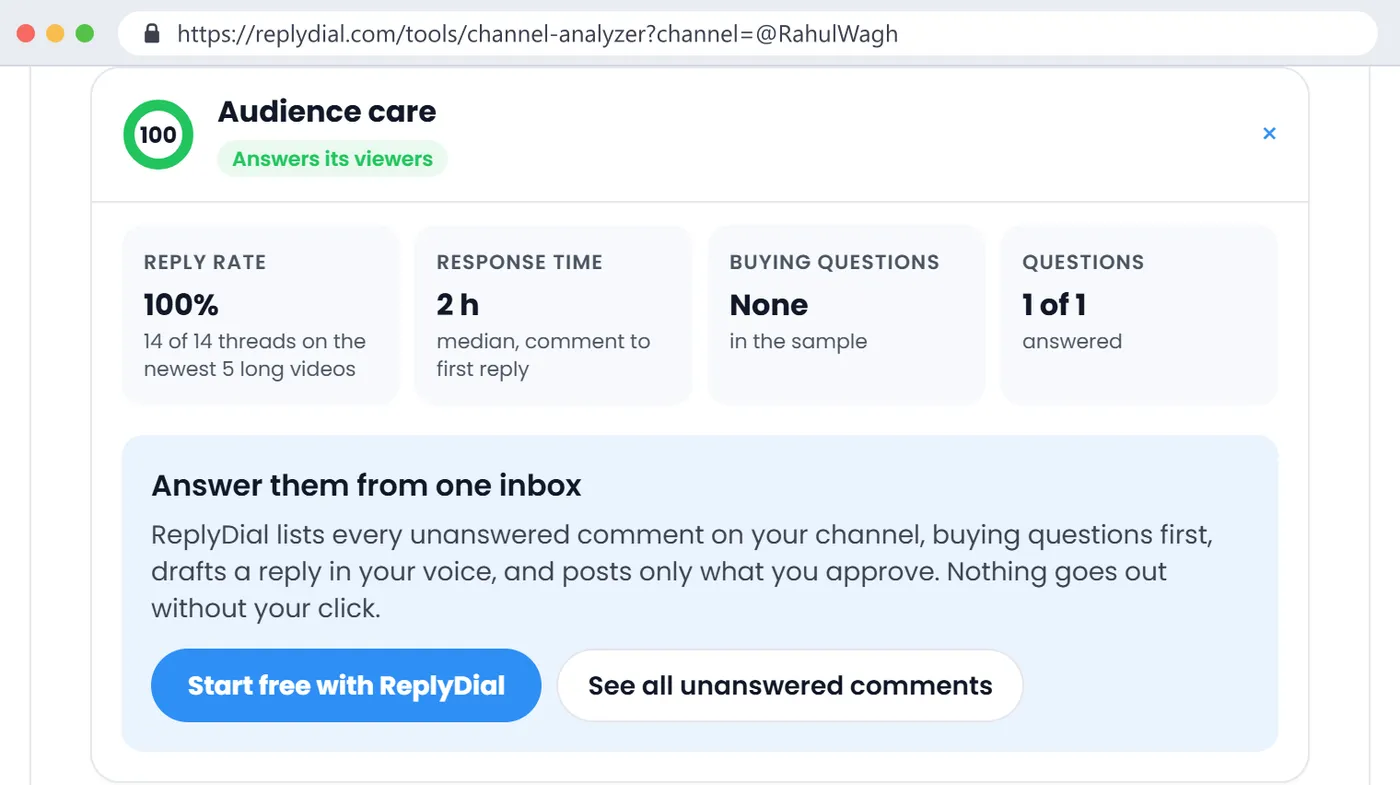
My own audience care section on 30 October 2026: 14 of 14 threads answered, median 2 hours, no buying questions in the sample, 1 of 1 questions answered. Fourteen threads is a small sample and the report says 'on the newest 5 long videos' under the number for that reason.
What broke, and which decisions in the method are mine?
The sample moved under me between two days. Nana's report read 202 of 223 on 30 October and 205 of 226 on 31 October. Three new comments, no new replies. I had written "202 of 223" into a draft of this post and had to change it, which is a small example of why every number in the analyzer carries the date it was read.
My own report was stale for an hour after the release that added the score. The previous day's report was cached and served as fresh, so the audience care section showed "not measured yet" on a channel I had just measured locally. Reports now carry a version number, and a cached report from an older version is scanned again on the next open.
The first production test of two people opening the same channel at once ran three scans instead of one, on 30 October at 07:16 UTC, because the check for a running scan sat after the first network call. After the fix the same test produced one scan and two joins, and the cache moved from the server's memory into the database so a second server does not repeat the work either.
The rest are decisions, and I want them visible. Threads whose top-level comment was written by the channel are dropped, so a pinned "links below" comment is not counted as a viewer waiting. A reply is the channel's when its author id matches the channel id, not when the display name matches, because names change and fans borrow them. A video with comments turned off is counted and skipped, and a channel with all five off shows "Comments off" rather than a 0, because turning comments off is a decision and a 0 would misdescribe it. The score needs 10 threads and the red flag needs 20: under 10 the section shows a dash and "too few comments", and between 10 and 19 you get a number but no flag, because 3 answered of 11 is a true 27 percent and a meaningless one.
What does a low reply rate cost?
I can only measure my own side of this, and I have been careful in the seven-years post to say what I cannot prove: YouTube does not publish whether replies feed the recommendation system, and my analytics do not isolate it. What I can show is behaviour under the videos.
Under my five most-viewed videos, 25 percent of comments are questions and 6 percent are "it fails at step X" reports. When those get answered, the thread can continue: 20 of my 629 replies ended with a question back. When they do not get answered, the next viewer with the same problem reads the silence and asks nowhere. On Nana's newest five videos there are 29 questions with no reply; on NetworkChuck's there are 95; on Abhishek's 28 with 8 answered. Each of those is a viewer who typed a question in public and got nothing, and I do not need the algorithm to tell me what that teaches the next viewer about typing one.
The brand side is more concrete. In the vetting checklist I put the comment check at minute 8 to 11 because agencies told me they do it by hand: scroll the comments under the last sponsored video and see whether the creator answered anyone. A channel that answers 1 percent of comments will answer 1 percent of the comments under the sponsored video too, and the brand's "is the code still valid?" will sit there. The audience care score puts that number on the first screen of the report, next to the sponsor history, which is where the person deciding on the deal is looking.
How do you raise the reply rate without spending a day a week?
The rate on the eight channels tracks one thing more than any other: whether the creator is working from a list or from a feed. YouTube Studio shows comments as a feed, newest first, across all videos, with filters that reset, and the Studio tools post goes through what it can and cannot do. A feed is read until the reader is tired. A list is worked until it is empty.
What worked for me at 200 comments a week, from the post about it: one inbox of every unanswered thread across the whole channel, sorted so the questions and the buying ones come first and the thank-yous last; drafts for each in my own voice that I edit or discard; one click to post, nothing automatic. The time went from the 10 hours a week it would take at 3 minutes a comment to under 3 hours, most of it reading, and the reply rate on my newest videos went to the 100 percent in the table above. That tool became ReplyDial, and I will not pretend this post is independent of it; the measurement, though, is independent, and the 20-video checker and the open-source CLI both run with no account.
Three things that need no tool at all, in the order that moves the score:
Answer the questions on your five newest videos first, oldest unanswered first. On most channels that is 10 to 30 comments, and it moves the rate from single digits past the 30 percent flag line in one sitting, because questions are a quarter of comments and the thank-yous can wait.
Answer every buying question the day it arrives, with the link or the price, and pin the answer if the question repeats. These are 1 percent of comments and 30 percent of the score, and they are the only comments with a sale behind them.
Reply within a day on the first day, then once a week on the backlog. The response-time part is a median, so a channel that answers most threads within 24 hours keeps the full 30 points even if the backlog clear takes a week. The first-day habit most big creators already have is half of this score; the weekly list is the other half.
What this means for you
Reply rate is measurable for any channel from public data: answered threads over all threads on the newest videos, with the channel's own comments removed. The analyzer does it in 5 API units; the checker does 20 videos in about 22.
Across eight established tech channels the median rate was 15 percent, and the only three over a third were all under 300,000 subscribers. Size and reply rate move in opposite directions.
Under 30 percent on 20 or more recent threads is the red-flag line. 70 and above is "answers its viewers". Those are my lines, not YouTube's, and the rules are on the page.
The buying questions are 1 percent of comments and the ones that cost money when they go cold. Of 19 across seven channels, 1 had an answer.
The sample has limits: 5 videos, 100 threads each, up to 5 replies per thread, hearts invisible, a day-old video counted the same as a month-old one. The 20-video checker matched it within 2 points on the two channels I cross-checked.
Working from a list instead of a feed is the whole trick. The questions first, the buying ones the same day, the thank-yous when there is time.
Quick answers
What counts as a reply from the channel? A reply inside the thread whose author id is the channel's id. Hearts, likes and pinned comments do not count, and a reply from the creator's second account does not either.
Does the reply rate include Shorts? No. The sample takes the newest 5 long videos. Shorts comments have different volume and a different audience, and mixing them in made the rate jump around between scans.
My rate shows a dash. Why? Fewer than 10 viewer threads in the sample. Small channels and channels with comments off land here. Run the 20-video checker for a bigger sample, or read the section again after the next upload.
Can I see the reply rate for a channel I want to sponsor? Yes, in the free report for any public channel, under the scores, with the date it was read. Compare it with the sponsor history in the same report before you write to the creator.
Is replying to comments allowed to be automated? Drafting can be assisted; posting cannot be unattended. YouTube's API policies and spam policy both require a person to decide each reply, and the post on what is allowed goes through the rules. Nothing in the audience care score rewards volume over judgement: a copied "thanks!" under 200 comments would move the rate and not the viewers.
How often does the number update? A report is reused for 24 hours and can be refreshed after an hour. The sample is live, so the number on a channel that is answering its backlog will rise within a day of the work.
This week, with no tool: open your newest five videos, sort the comments by newest, and answer every question and every "how do I get this" before you answer a single thank-you. Count how many there were; that number is your real inbox.
ReplyDial turns that inbox into a list across your whole channel, drafts each reply in your voice, and posts only what you approve; the free checker shows the unanswered count on your last 20 videos first. Companion video: none yet. Newsletter note: the issue will run the eight-channel table again a month later to see which rates moved.
See your own unanswered comments
ReplyDial lists every comment on your channel still waiting for a reply, drafts answers in your voice, and posts only what you approve. Free for 7 days on Creator limits, no card.
A filtered list beats YouTube search: niche, subscriber range, country and upload pace, with sponsors on each row. What 602 channels showed on 3 Nov 2026.
Consistency, engagement, discoverability, commercial readiness and audience care, 0 to 100 each from public data. The rules, my scores, 8 channels compared.
Seven checks from public data, in order, with a time budget: sponsor history, cadence, the segment, the comments, reachability, brand safety, then what to ask.