Should you reply to every YouTube comment? Seven years of data
Yes, with four exceptions. What replying to every comment cost and returned on a 104k channel with a day job: 629 replies measured, 33 channels compared.
Yes, reply to every comment, with four exceptions: abuse with no question in it, spam, bots, and the "first" and "who is watching in 2026" crowd. On my channel that leaves about 95 percent of comments, and answering them takes me roughly 2.5 hours a week at 200 comments, most of it in one-line replies. I cannot prove to you from YouTube's analytics that replying grew the channel, and I will show you exactly what I can and cannot prove. What I can show is what it costs, what comes back, and what happened on the channels that do not do it.
I have run a DevOps tutorial channel, 104,000 subscribers today, for nearly seven years alongside a full-time engineering job in Sweden. On 13 October 2026 I exported every reply I had posted under my five most popular videos, 629 of them, and measured them. On 6 October I scanned 33 other established creator channels, read-only, to see what their comment sections look like. Those two data sets, plus my Studio, are the evidence here. Where I am giving an opinion rather than a number, I say so.
What does "every comment" actually mean in numbers?
From the 13 October export of 629 replies across five videos (AWS VPC, EC2 full course, IAM, Helm, Ansible):
1,599 comment threads on those five videos; I replied in 629 of them, and most of the rest were replies to each other, spam, or the four exceptions.
Median reply: 21 characters. 487 of 629 replies are under 80 characters. "You are welcome" appears 58 times in exactly those words.
291 replies went out the same day as the comment; the median wait was 1 day. 34 took over a month, all in backlog clears.
46 percent of comments are thank-yous. 25 percent are questions, 6 percent are "it fails" reports, 1 percent are requests, 22 percent are everything else.
20 replies end with a question back. 10 are a link to another video.
What arrives
Share
What a reply costs me
Thank-you or praise
46%
10 to 20 seconds, one line
Question about the topic
25%
1 to 3 minutes, or 15 seconds for a link
"It fails at step X"
6%
1 to 5 minutes, often a question back first
Request for a video
1%
20 seconds
Opinions, corrections, jokes, noise
22%
10 seconds, or nothing
Put those together and "every comment" at 200 a week is: 92 one-liners (about 25 minutes), 50 questions (about 90 minutes), 12 error reports (about 30 minutes), and the rest in change. That is the 2.5 hours. The number people imagine, three warm sentences per comment, would be eight hours, and that is the number that makes creators give up on replying entirely.
What do channels that do not reply look like?
On 6 October 2026 I ran a read-only scan, public data only, of 33 established US creator channels: course sellers and teaching channels between 10,000 and 1,000,000 subscribers, all several years old. The scan read the newest comments on each channel's recent videos and counted the ones with no reply from the channel.
Channel size
Channels
Comments read
No reply from channel
Under 50,000 subscribers
4
825
82%
50,000 to 200,000
15
3,848
69%
200,000 to 1,000,000
14
7,314
78%
All 33
33
11,987
75%
Three of every four recent comments on those channels had no answer. Twenty-one of the 33 channels were above 80 percent unanswered. The most attentive channel in the set still left 16 percent unanswered; the least attentive had answered none of its last 415. Many of these channels sell courses, and several pin a comment inviting questions. The questions are there, under their videos, unanswered: on one 280,000-subscriber channel, 1,123 of the newest 1,296 comments had no reply, and 39 of them were someone asking how to buy, join or get a link.
That is the comparison I keep in mind when the 2.5 hours feel like a lot. The alternative is not "fewer replies". For most channels the alternative is a comment section where three quarters of the people who wrote something were talking to nobody.
What did replying do for my channel? What I can and cannot prove
Here is where most posts on this topic start making things up, so let me be careful.
What I cannot prove. I cannot show you an analytics chart where replies cause views. YouTube does not expose that, and the honest answer about the algorithm is that nobody outside YouTube knows how much weight a creator reply carries. I have seen the claim that replying "signals engagement" and I believe it is probably true in some small way, and I will not put a number on it because I do not have one. If you came here for "replying increased my views 40 percent", I do not have that, and I would distrust anyone who does.
What I can show. Three things from my own data.
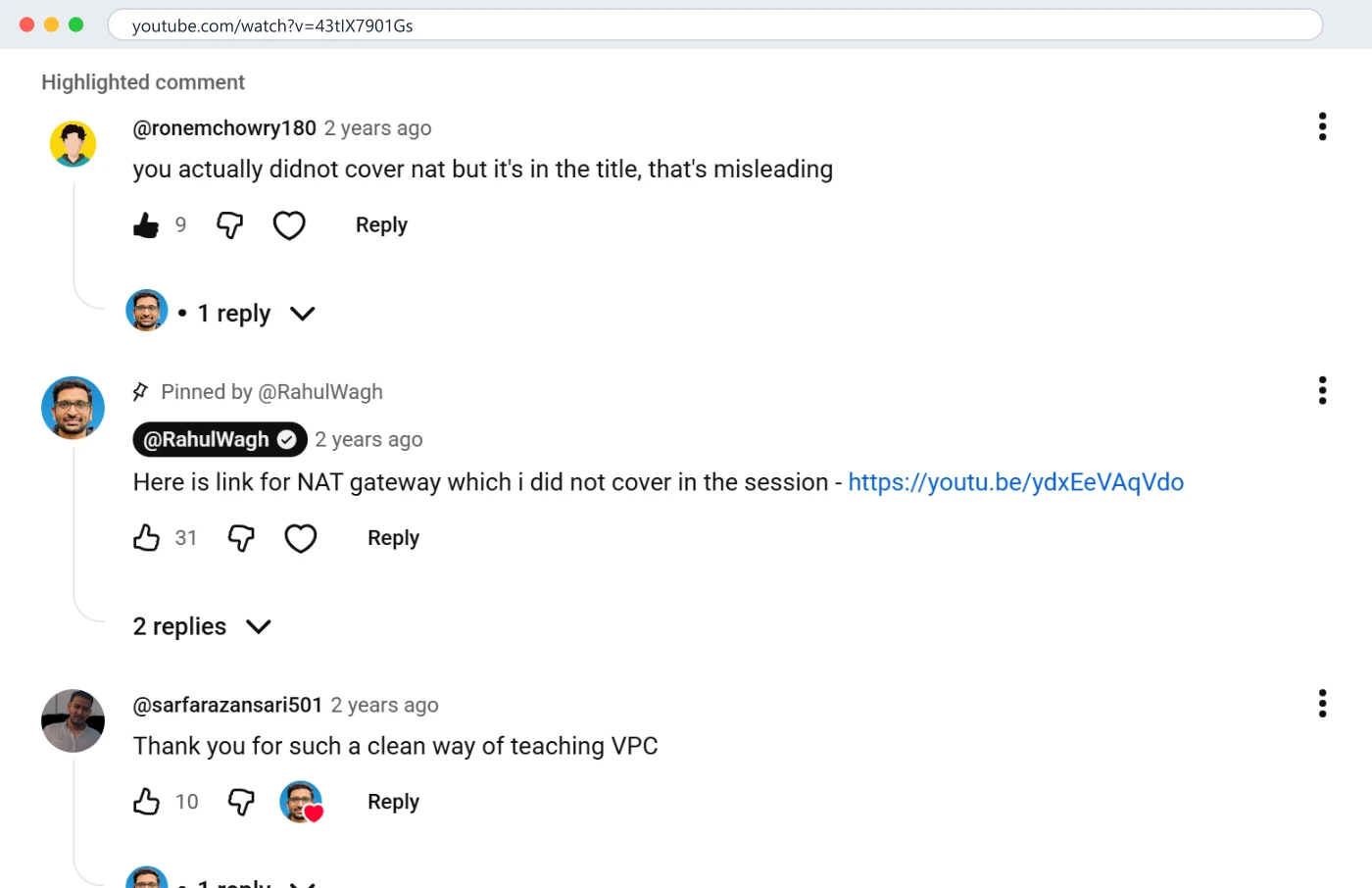
First, replies get read. The most-liked thing I have ever posted under the VPC video is not a comment of mine but a pinned reply with a missing link, 31 likes, more than the 9-like complaint that prompted it. People scroll the comments and they read the creator's answers.
The VPC video's comment section, 13 October 2026: a viewer's complaint at 9 likes, my pinned reply with the missing link at 31. The reply became the most useful item on the page. Click to enlarge.
Second, questions repeat, and an answered question is a resource. The export shows the same questions arriving for years: NAT gateways for private subnets, CIDR, "does this work on Terraform 1.9". Each public answer is read by the next person with the same problem before they ask. When I did not answer, the same question arrived again a week later. When I did, it often did not.
Third, the follow-ups are where the relationship is. Twenty of my 629 replies end with a question back, and a good share of those turned into a second exchange, where the viewer explains their actual situation and the real answer becomes possible. One viewer on the EC2 course asked a vague question in August 2024, got "What are you trying to achieve?", answered, got a specific fix, and came back in April 2026 with a bigger architecture question that deserved a long reply and got one. That is a two-year conversation with someone who has presumably watched a lot of my videos in between. I cannot measure it. I also cannot pretend it is not worth 3 minutes.
What replying did for me, as opposed to the channel. This is opinion. Reading and answering 200 comments a week for years is the single best source of video ideas I have had, better than any keyword tool, because the comments tell me which step people fail at. It is also how I found out my hashtags-and-links filter had been off for seven years, how I learned that a diagram in the VPC video had the wrong CIDR, and how I knew that a five-hour EC2 course was the right length for my audience despite the comment telling me it should be one hour. The feedback loop only works if you are in it every day.
When should you not reply?
The four exceptions, with how I recognise each.
Abuse with no question. If a comment is only an insult, there is nothing to answer, and answering gives the insult an audience. On 11 October there was one held comment on my channel from the previous month, a viewer swearing at me because the AWS free tier does not apply to organisation accounts. The complaint underneath was fair, so I will answer the same question politely when the next person asks it, as one did this week. The swearing itself gets no reply. The line I use: if removing the insult leaves a question, answer the question and ignore the insult; if removing the insult leaves nothing, leave it.
Spam. Crypto, "I made $10k with", the lookalike accounts that copy a creator's name and photo to post scam links under their own videos. I wrote about those in spam, scams and lookalike comments. Never reply; replying boosts the thread. Report, remove, hide the user.
Bots. Generic praise that fits any video ("Great content, keep it up!!!") from accounts with no history, usually in clusters. Some are harmless, some are the first move of a scam. I do not reply, and I do not remove unless they link somewhere.
"First" and "who is watching in 2026". Harmless, and not addressed to me. In September 2026 I let an AI draft a reply to one of those and approved it ("Thanks for watching! Hope this VPC setup guide is helpful for your AWS learning journey. 🙌"). It is the reply I most regret in the export, not because it is rude but because it is pointless: nobody wanted an answer. These get a like at most.
Everything else, including criticism, gets a reply. The criticism especially: "too verbose", "mic is bad", "the diagram is wrong", "you did not cover NAT but it is in the title" all got answers, and three of those four got a fix or a link. Criticism answered in public is the cheapest trust you can buy.
Does the length of the reply matter?
This is the question that decides whether "every comment" is possible, so here is the data again from a different angle. Before September 2026, my replies had a median length of 21 characters. Then I started using my own tool to draft replies and approving them too quickly, and the 39 replies from that period have a median of 169 characters, with 95 percent ending in an exclamation mark and 23 of 39 opening with some form of "thanks for watching". I wrote the full comparison, with examples, in 40 real YouTube comment replies.
The point for this post: the long replies were not better. They were eight times longer and said the same thing. A viewer who writes "Thank you so much!" wants to be seen, and "You are welcome" sees them in two seconds. A viewer who writes "step 4 fails with a 403" wants the fix, and the fix is one command. Long replies are not kindness; they are the thing that makes "every comment" impossible, and then the creator stops replying to anyone.
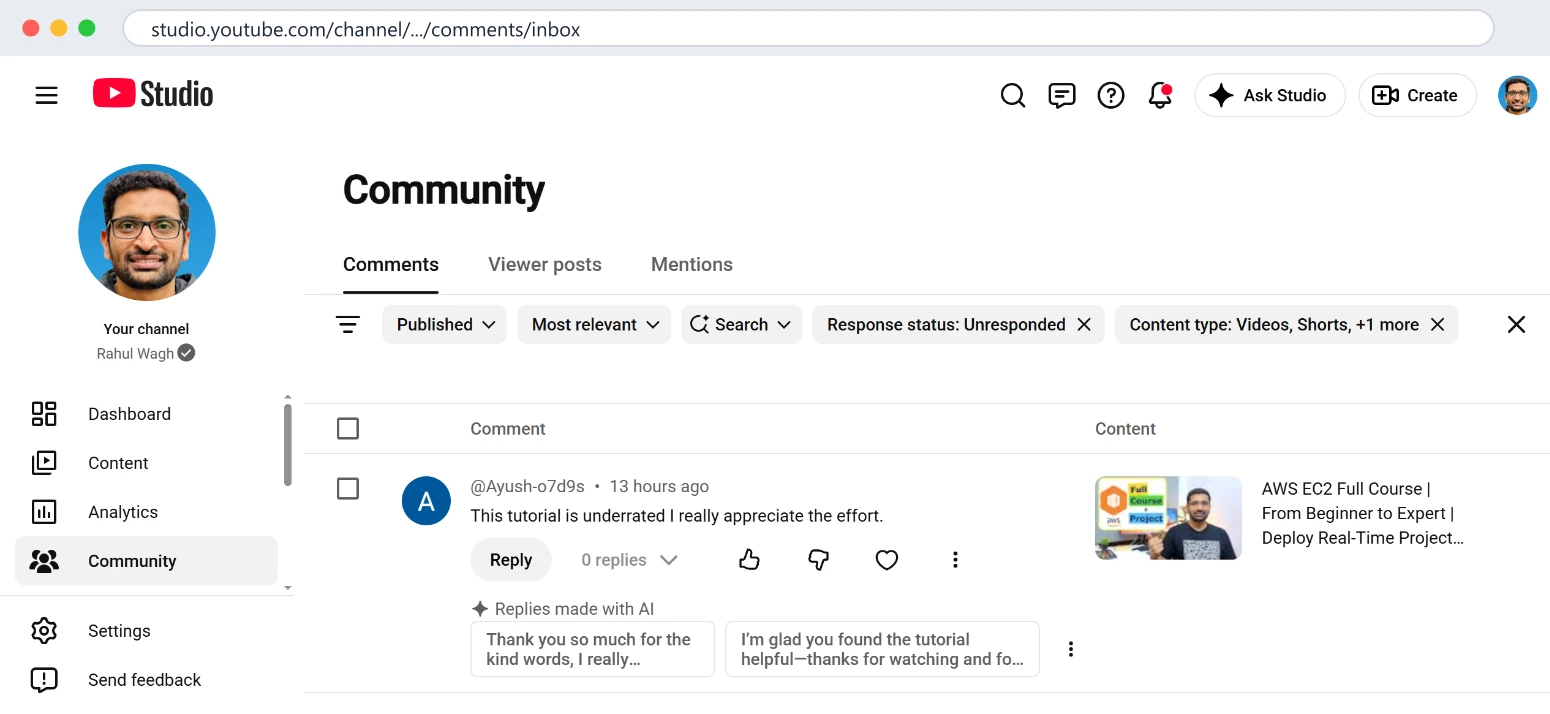
YouTube Studio's own AI reply suggestions on my channel, 11 October 2026, under a thank-you comment. Both are longer than anything I would type. Length is the enemy of every.
How do you fit it around a job?
The honest schedule, not the aspirational one. I answer comments once a day, 20 to 30 minutes, on the phone, on the train or on the sofa. The order inside that half hour:
Questions and error reports first. These are the ones where a same-day reply changes something: the viewer still has the terminal open.
Criticism second. Short, specific, ask for the timestamp if it is about production quality.
Thank-yous last, in a run, one line each, varying the line. If I am out of time, these wait until tomorrow, and nobody has ever complained about a thank-you answered a day late.
Things that made it survivable:
One list for the whole channel, newest first. In Studio that is the Community page with Response status: Unresponded and the sort set to Newest. Most of my comments are on videos from 2021 to 2023, not this week's upload, and a per-video habit misses them. Here is what a normal fortnight looks like on my own tool's ledger:
Day
Replies posted
2026-10-08
3
2026-10-07
4
2026-10-06
3
2026-10-04
5
2026-10-02
4
2026-09-30
4
2026-09-29
1
2026-09-28
34
2026-09-27
22
The 56 replies on 27 and 28 September were a backlog clear on old videos; the three to five a day after it is the steady state. Three to five a day is not a burden. The backlog was.
Reply the same day or accept it will be short. 291 of 629 replies were same-day, and those are the short ones. The ones that waited a month got longer, apologetic, and were often too late to matter.
Come back to threads. A reply is not the end. Two days later, open the threads you answered; the follow-up is where the real question usually is, and no view in Studio flags it. My tool brings those threads back automatically now; before 6 October 2026 it did not, and I missed a second viewer's question inside a thread I thought was done.
Stop reading the bell. The notification bell is a river, not a list. The Unresponded view is a state you can empty.
What does a week of "every comment" actually contain?
Numbers are abstract, so here is the texture, from the same export, verbatim. A normal week on my channel is roughly this mix, and these are the real replies.
A thank-you, 5 February 2026, "Thank You Sir. Worth it Watching":
So glad you found it worth watching!
A question, 26 October 2023, how an instance in a private subnet reaches the internet:
You need to setup the NAT gateway for the private subnet so that EC2 instance running instance inside private subnet can access to internet but all the access outside will be blocked for private subnet
An error report, 21 March 2024, "no such file or directory" when connecting with a key pair:
Run the ls -lart command to see if the keys are available in the directory or not.
A complaint, 8 May 2024, "please improve your mic quality very bad sound quality":
Thanks for the feedback can you please point me where you felt the sounds quality was poor so that i can work upon
A request, 28 March 2024, for videos on RDS, DynamoDB and ElastiCache:
Sure it is on my list and I need to find the time to prepare
Five comments, five replies, 61 words between them, perhaps four minutes in total. Multiply by 40 and you have the week. Nothing in it is eloquent. All of it is an answer.
What does the comment section look like when you stop?
I have the read-only scan of the 33 channels, and the uncomfortable part is not the percentage. It is what the unanswered comments say. On the 280,000-subscriber channel with 1,123 unanswered out of 1,296, the free checker found 39 comments that were someone trying to buy, join, get a link, or ask the price. Those are not "great video" comments. They are customers, in public, asking the seller a question, and the seller's silence is visible to every other viewer who scrolls past.
On the teaching channels in the set, the unanswered comments were mostly the same three kinds I get: "step X fails", "does this work with version Y", and "thank you". A creator who answers none of them is not saving 2.5 hours a week. They are leaving the FAQ for their own video unwritten, and the next viewer with the same error reads the unanswered question and assumes nobody is home. Our free unanswered comments checker shows this for any public channel in a minute; try it on a channel you admire, then on your own.
How much time, for your channel size?
Using my mix (46 percent thank-yous at 15 seconds, 25 percent questions at 2 minutes, 6 percent errors at 3 minutes, the rest at 15 seconds) as the starting point. Your mix will differ; a vlog gets more thank-yous and fewer error reports than a tutorial channel.
Comments a week
Thank-yous
Questions
Errors
Time a week
A day
50
23
13
3
about 45 minutes
7 minutes
200
92
50
12
about 2.5 hours
20 to 25 minutes
500
230
125
30
about 6 hours
50 minutes
1,000
460
250
60
about 12 hours
1.7 hours
Below 200 a week, "every comment" is a daily habit smaller than most people's social media scrolling. Between 200 and 500 it is a real time cost and still, in my experience, worth it, if the replies stay short. Above 500 a week, you need either help, or a rule that answers every question and error and lets thank-yous go in batches, or a tool that drafts the one-liners so you only approve them. The one thing that does not work at any size is the long reply; at 1,000 a week and three sentences each you would be at 40 hours.
What about the mindset part?
Because the question "should I reply to every comment" is rarely really about time. It is about three fears, and I have had all three.
The fear that replying looks needy. It does not. It looks like a person who reads their comments. Every creator I respect answers comments; the ones who do not usually have a team that does, or have decided their audience is a number.
The fear of the critical comment. The export has every critical comment I have ever answered on those five videos, and none of them did any damage. "Too verbose" got "thanks for the feedback". "Misleading title" got the missing link and a pinned comment. The diagram error got a thank-you and a note. The comments that hurt are the ones you do not answer, because they sit there with the last word.
The fear that it never ends. It does not end; that is the deal. But it does become small. At three to five replies a day it is a habit like checking email, and it has one property email does not: every reply is public, so every answer is reused by the next viewer with the same question. You are not answering one person. You are writing the FAQ for the video, one line at a time, in front of everyone.
What this means for you
Reply to everything except abuse, spam, bots and "first". That is about 95 percent of comments on a tutorial channel, and most of it is one line.
Budget by type, not by comment: 20 seconds for thanks, 3 minutes for a question, a question back when you cannot tell what they mean.
Same day beats thorough. Short beats long. "You are welcome" is a complete reply.
Use one whole-channel list sorted by Newest, not the bell and not this week's video.
Answer criticism in public, briefly, and ask for the timestamp.
Come back to answered threads two days later.
Do not let an assistant, YouTube's or anyone's, make your replies longer than you are. Read your last 20 replies in a list once a month.
Questions people ask
Should I reply to comments on old videos?
Yes, and on a tutorial channel most of your comments are on old videos. The majority of my 629 replies are on videos from 2023 and 2024 that still get traffic from search. A question under a two-year-old video is a viewer who found you today.
Should I reply to comments in a language I do not speak?
I get comments in Hindi, Marathi, Telugu, Arabic and Spanish. I answer in English, briefly, and most viewers who commented in another language can read it; the comment often came after watching an English video. For a request to dub a video, "not planned, sorry" is a complete reply.
Is a heart or a like enough instead of a reply?
For "first", "who is watching in 2026" and emoji-only comments, yes. For a thank-you with a sentence in it, a one-line reply is better than a heart, because a reply is text the next viewer can read. For a question, no; a heart on a question reads as a dodge.
What if I have a team or a moderator?
Then decide who answers what. Questions about the content should come from you, in your voice; a moderator can handle removals, hides and the first reply to spam. If someone replies on your behalf, the viewer can usually tell, so say so in the channel description or keep it to housekeeping.
Does replying quickly matter more than replying at all?
Both matter, and quickly is cheaper. 291 of my 629 replies went out the same day, and those are the short ones; the viewer is still there, the context is fresh, and one line closes it. A reply a month later needs an apology and is often moot. If you must choose, answer today's comments today and clear the backlog on a weekend.
What to do this week, no tool needed: for seven days, open the Unresponded view once a day and answer everything in it in one line each, questions first. Count the minutes. On most channels under 500 comments a week it is under 30 a day, and that number is the real answer to "should I".
ReplyDial finds every unanswered comment on your channel, including follow-ups under threads you already answered, drafts a short reply in your voice, and posts only what you approve, one click each. The unanswered comments checker is free and tells you in a minute how many of your recent comments never got an answer.
See your own unanswered comments
ReplyDial lists every comment on your channel still waiting for a reply, drafts answers in your voice, and posts only what you approve. Free for 7 days on Creator limits, no card.
Does replying to YouTube comments matter? A 100k-subscriber creator found 155 unanswered questions on his own channel, some years old. What that silence cost in viewers, video ideas and trust, and what changed after answering them.
Every comment filter, queue and setting in YouTube Studio, with screenshots from my own 104k-subscriber channel taken this week: the Unresponded filter, the Held queue, blocked words, link holding, hidden users, AI reply suggestions, and the three things Studio still does not do for you.
How a 104k-subscriber creator sorts YouTube comments into answer, skip and report: YouTube Studio's own filters, what they miss, the comments that are not spam but not questions either, and the rule for replying without feeding the scammers.