How-to
How to find unanswered comments in YouTube Studio
Studio's Response status: Unresponded filter lists the comments you never answered. What it counts, what it misses, and my channel's numbers on 9 November 2026.
12 November 2026 · 16 min read
Blog · How-to
How the analyzer's discoverability score is built: six packaging checks with fixed weights. My 70 and three others, 54 to 70, recomputed by hand on 9 Nov 2026.
By Rahul Wagh·· 16 min read
The discoverability score on a channel analyzer report is a packaging score, not a traffic score. It reads the newest 300 videos of a channel through the public YouTube Data API and checks six things on each: are there tags, is the title between 40 and 70 characters, is the description at least 200 characters, does a long video have chapters, does it have uploaded captions, and is the video's language set. Each check has a fixed weight (25, 15, 20, 15, 15 and 10 points), the share of videos passing each check is multiplied by its weight, and the six products are added up. 70 or more reads "Well packaged", 40 to 69 "Gaps in packaging", under 40 "Hard to find". Nothing in it is a judgement about your thumbnails or your topic, because the API cannot see a thumbnail's click rate and the score only uses what the API returns.
I built the score, so I owe you the arithmetic. On 9 November 2026 I ran my own channel, @rahulwagh (Cloud & DevOps, 105,000 subscribers, 371 videos), and three channels in different niches through the analyzer, pulled the six counts out of each report, and recomputed the scores by hand. All four came out to the number on the page: 70 for me, 54 for Christian Lempa, 68 for Net Ninja, 70 for Chloe Ting. This post is the arithmetic, what each check actually measures, where my own channel loses its 30 points, and what the score deliberately does not know.
| Check, newest 300 videos | Weight | Passes when | @rahulwagh, 9 Nov 2026 | Points |
|---|---|---|---|---|
| Tags | 25 | The video has at least one tag | 245 of 246 | 24.9 |
| Title length | 15 | 40 to 70 characters | 129 of 246 | 7.9 |
| Description length | 20 | 200 characters or more | 244 of 246 | 19.8 |
| Chapters | 15 | A long video's description has timestamps that form chapters | 113 of 227 long videos | 7.5 |
| Captions | 15 | Uploaded or edited captions exist (auto-generated do not count) | 0 of 246 | 0 |
| Language | 10 | The video's default language is set | 246 of 246 | 10 |
| Total | 100 | 70, "Well packaged" |
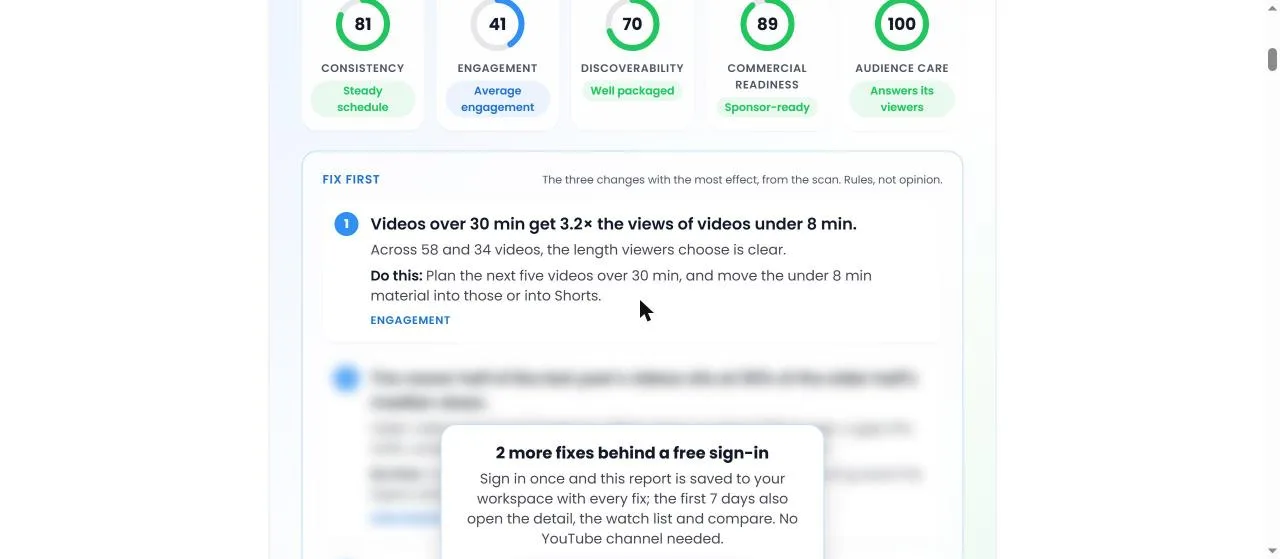
The six checks are deliberately boring. Each one is a field the YouTube Data API returns for every public video, each one is something the creator controls in the upload form, and each one can be fixed on an old video without re-uploading it. That is the whole design: the score should only contain things you can change this afternoon.
Tags, 25 points. The report reads the video's tag list and counts a video as passing if the list is not empty. Tags are a small ranking signal in 2026 and YouTube says as much, but they are the cheapest way to tell the system what a video is about, they are what the analyzer uses to read a channel's topics, and a channel with none is leaving a free field blank. 245 of my 246 videos have tags; the top ones are devops, aws, cloud, terraform, kubernetes and ansible, which is a fair one-line description of the channel.
Title length, 15 points. A title passes when it is between 40 and 70 characters. Under 40 it usually lacks the second keyword a search needs; over 70 it is cut off in most places YouTube shows it. My median title is 60.5 characters, inside the window, but only 129 of 246 titles are. The rest are the long ones: series titles with a part number, a pipe and a hashtag list run to 90 characters and more. That is 7.1 points left on the table.
Description length, 20 points. A description passes at 200 characters or more. The first two lines show in search and under the player, the rest is where chapters, links and the disclosure live, and a 40-character description gives YouTube almost nothing to match on. 244 of my 246 pass, and my median description is 2,772 characters, which is long even for a tutorial channel; the two that fail are old Shorts.
Chapters, 15 points. Measured on long videos only, because Shorts cannot have chapters. The report looks at the description for the timestamp pattern YouTube turns into chapters: a 0:00 line followed by at least two more timestamped lines. 113 of my 227 long videos have them, which is 7.5 of 15 points. Chapters show up as sections in search results and as the key moments bar on the player; on a 45-minute tutorial they are the difference between a viewer finding the Terraform part and leaving.
Captions, 15 points. This is the check that costs me the most and the one most creators misread. The API returns a single flag per video that says whether the video has caption tracks, and YouTube sets it for uploaded or edited caption tracks, not for the automatic ones. On my channel the flag is false on all 246 videos. Every one of them has automatic captions in the player; none of them has a caption track I uploaded or corrected. For a channel whose audience is mostly non-native English speakers watching command-line tutorials, that is 15 points and a real accessibility gap in one number.
Language, 10 points. Passes when the video's default language field is set. It is a two-click setting in the upload form, and 246 of 246 of mine have it. It is worth 10 points because it decides which automatic translations YouTube offers and which language search results a video can appear in; a channel with it blank on every video is harder to find outside its home market for no reason at all.
Yes, and I think you should, at least once, so you know it is arithmetic and not opinion. The report shows the six counts; the formula is the one above. Here are the four channels I ran on 9 November 2026, with the parts rounded to one decimal.
| Channel, newest 300 read | Tags | Title 40 to 70 | Description 200+ | Chapters on long | Captions | Language | Score on the report |
|---|---|---|---|---|---|---|---|
| @rahulwagh, Cloud & DevOps, 105K | 245/246, 24.9 | 129/246, 7.9 | 244/246, 19.8 | 113/227, 7.5 | 0/246, 0 | 246/246, 10 | 70 |
| @christianlempa, Cloud & DevOps, 278K | 30/300, 2.5 | 196/300, 9.8 | 288/300, 19.2 | 207/243, 12.8 | 1/300, 0.1 | 300/300, 10 | 54 |
| @netninja, Programming, 1.9M | 300/300, 25 | 258/300, 12.9 | 298/300, 19.9 | 0/285, 0 | 1/300, 0.1 | 300/300, 10 | 68 |
| @chloeting, Fitness & health, 26.1M | 281/299, 23.5 | 216/299, 10.8 | 281/299, 18.8 | 11/273, 0.6 | 128/299, 6.4 | 299/299, 10 | 70 |
Add each row and round: 70, 54, 68, 70. The four channels have four very different shapes, which is the point of showing them together:
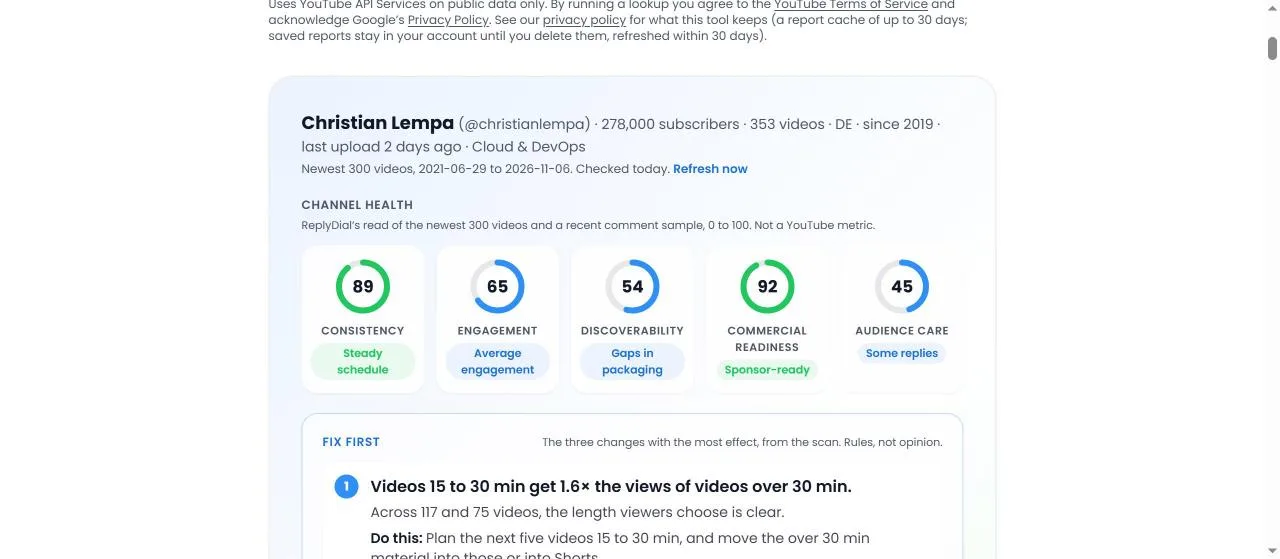
Because the score measures packaging, and packaging is not success. Christian Lempa's channel outgrows mine on every public number that matters: 278,000 subscribers to my 105,000, a consistency score of 89 to my 81, an engagement score of 65 to my 41, 38 sponsoring brands on his Discover row against my 7. His discoverability score is lower because the channel does not fill in the tags field, and the formula weights that field at 25 points because it is the field the analyzer itself reads to learn what a channel is about.
That tells you how to read the dial. A high discoverability score says "this channel has done the free, mechanical work that helps search and recommendations understand each video". A low score says "there are empty fields". It does not say the channel is hard to find in practice; a channel with a strong audience and strong thumbnails will be found regardless, and the score cannot see either of those things. A low score on a growing channel is a list of cheap wins. A low score on a stalled channel is one of the first places to look.
The same logic applies to the verdicts. "Well packaged" at 70 does not mean finished; I have 30 points of empty fields. "Gaps in packaging" at 54 does not mean broken; Christian Lempa has one gap. The verdict thresholds (70 and 40) are fixed so that two channels scored on different days are comparable, which is what agencies vetting a shortlist need. If you want the full view of how the five scores fit together, the analyzer report, section by section walks through all five on my channel, and five numbers that make a channel health score explains why there are five dials and not one.
Under the discoverability block the report also shows title patterns: how many of the channel's titles contain a number, start with "How to", ask a question, use brackets, use a colon, or contain "vs", and the median views of videos with that pattern as a multiple of the channel's own median. The patterns are not in the score, on purpose, because they measure what worked on one channel, not what is correctly filled in. They are the most channel-specific lines on the page.
On my channel on 9 November 2026: titles with brackets, 48 videos, get 2.7 times my median views; titles with a colon, 38 videos, 1.4 times; titles asking a question, 70 videos, 1.2 times; titles with a number, 171 videos, 1.1 times; titles starting with "How to", 29 videos, 0.9 times; titles with "vs", 5 videos, 0.3 times. The brackets line is mostly my series markers, "(Part-5)" and the like, on the AWS and Terraform tutorials that became the channel's most viewed videos, so the multiple is partly the series and partly the bracket. I still take the hint: the five best-viewed videos on the channel, at 13.6 to 18.6 times the median, all have a part number or a course marker in the title.
Christian Lempa's table is the opposite shape: "How to" titles, 16 videos, at 2.1 times his median, "vs" titles, 15 videos, at 1.7 times, and titles with a number, 56 videos, at 0.4 times. Same niche, different audience habit. That is why the pattern multiples stay out of the score and sit in the detail: a rule that rewards numbers in titles would be right for me and wrong for him.
Four things, and I want to list them so nobody treats the dial as a search ranking.
Thumbnails. The API returns the thumbnail image, not its click-through rate. Click-through rate is in Studio Analytics and visible only to the owner. A packaging score that guessed at thumbnails would be guessing.
Impressions and search traffic. Also owner-only. The score cannot tell you how often YouTube showed your video or where the clicks came from.
Keyword demand. The score does not check whether anyone searches for the words in your tags. A perfectly tagged video about a topic nobody wants scores 25 on tags. That is correct behaviour for a packaging check and useless as a topic check; for topics, the engagement block's top videos and the title patterns are the honest signals.
The automatic captions. The captions check uses the API flag for caption tracks, which is true for uploaded or edited tracks and false when only the automatic ones exist. A channel that relies on automatic captions scores 0 on the check even though viewers see captions. I chose that reading deliberately: automatic captions on a command-line tutorial misspell every tool name, they are not indexed the way uploaded tracks are, and uploading a corrected file is the fix the score is pointing at. But it means my 0 of 246 overstates the problem for a channel with clean speech and simple vocabulary, and you should read it with that in mind.
Two things broke, one in the data and one in my own channel.
The data problem: Net Ninja's title patterns came back with "with a number" on 290 of 300 titles and no multiple next to it. The multiple needs at least five titles with the pattern and at least five without, and with 290 of 300 there were not enough without. The report prints the count and leaves the multiple blank rather than printing a number computed from a handful of videos, which is the right behaviour, but on first read it looks like a missing value. If a pattern line on your report has a count and no multiple, that is why.
My channel's problem is the captions row: 0 of 246. Fixing it is not an afternoon. Uploading a corrected caption file for a 45-minute tutorial is real work, and I have 227 long videos. So the plan I wrote down on 9 November 2026 is narrower than "do all of them": the five most viewed videos first, the ones at 13.6 to 18.6 times my median, then every new upload from now on. Five corrected tracks move the captions share from 0 to 2 percent and the score by less than a point, which tells you the score is not what I am fixing it for; the viewers who watch with captions on are.
The second thing I am fixing is cheaper: chapters on the 114 long videos that lack them. Each one is a description edit, two minutes a video, and all 114 together are worth 7.5 points. I will do them from the oldest high-traffic ones down, because the key moments bar matters most on the long tutorials people arrive at from search.
Titles I am leaving alone. Shortening a published title on a video that already ranks is a risk I do not need to take for 7 points; the fix is for the next upload, where the series marker goes in brackets and the hashtags go in the description.
Every one of the six checks is edited in YouTube Studio on a published video, without re-uploading and without losing the video's views, comments or ranking history. This is where each field lives on desktop Studio as of 9 November 2026, and what each fix would do to my own 70.
| Fix | Where in Studio | Time per video, from my own edits | Points it is worth on @rahulwagh |
|---|---|---|---|
| Tags | Content, open the video, Details, Show more, Tags | Two to five minutes | 0.1 (245 of 246 already pass) |
| Title into 40 to 70 characters | Content, open the video, Details, Title | One minute, but only for new uploads | 7.1 (129 of 246 pass) |
| Description to 200+ characters | Content, open the video, Details, Description | Two minutes | 0.2 (244 of 246 pass) |
| Chapters | Same description field: a 0:00 line, then at least two more timestamps in order, each section 10 seconds or longer | Two to ten minutes, depending on the video's length | 7.5 (113 of 227 long videos pass) |
| Uploaded captions | Subtitles in the left menu, pick the video, Add, then upload a file, auto-sync a transcript or type | Thirty minutes to several hours for a 45-minute tutorial | 15 (0 of 246 pass) |
| Video language | Content, open the video, Details, Show more, Video language | Ten seconds | 0 (246 of 246 pass) |
Two numbers from that table changed my plan. The first is that chapters and captions together are 22.5 of my 30 missing points, and they are the two fields that also change what a viewer experiences, not just what a crawler reads. The second is that the title points are not worth chasing on the archive: 7.1 points for editing 117 titles on videos that already rank is a bad trade, so that fix is a rule for the next upload only.
The arithmetic for the targets is the same formula run forward. Captions on every video would take my 70 to 85. Chapters on the remaining 114 long videos would add 7.5 and take it to 92. Titles inside the window on every video would be the last 7 and make it 100. Nobody needs 100; the point of running it forward is to see that the two expensive fixes are also the two that matter, and the cheap one left is worth almost nothing on my channel because it is already done.
For the other three channels the forward arithmetic is just as plain. Christian Lempa's 54 becomes 76 with tags on the 270 videos that lack them, a few minutes a video and the single highest-value edit on any of the four channels. Net Ninja's 68 becomes 83 with chapters on its 285 long videos. Chloe Ting's 70 becomes 84 with chapters on 262 long videos, and the captions she already has on 128 videos would be worth another 8.6 points if they covered all 299. None of those figures is a prediction about views. They are what the dial would read, which is all a packaging score can promise.
This week, without any tool: open your five most viewed long videos in Studio, add a 0:00 chapter list to any description that lacks one, and set the video language if the field is blank.
ReplyDial's analyzer is where these numbers come from: five scores with their counts, the three fixes with the most effect, the niche and what the channel sells, and every sponsor with evidence, free and without a sign-in at replydial.com/tools/channel-analyzer.
ReplyDial lists every comment on your channel still waiting for a reply, drafts answers in your voice, and posts only what you approve. Free for 7 days on Creator limits, no card.
How-to
Studio's Response status: Unresponded filter lists the comments you never answered. What it counts, what it misses, and my channel's numbers on 9 November 2026.
12 November 2026 · 16 min read
How-to
Paste a video link into the free exporter and download its comments as a CSV: author, text, likes, date, link. My 2023 VPC video gave 365 rows in one minute.
11 November 2026 · 24 min read
How-to
Filter a channel inventory by niche, size and has-sponsors, then read the brand chips per row. On 8 Nov 2026 I got 14 Cloud & DevOps channels and who paid them.
10 November 2026 · 25 min read