YouTube comment anxiety: how I read 200 comments a week
Seven years of reading my own comments without it ruining the day: what 964 recent ones contain, the three that hurt, and the routine that keeps me reading.
If you dread opening your YouTube comments, the single most useful thing I can tell you is what is actually in there, counted. On my channel, out of the 964 most recent viewer comments on my five most popular videos, 312 contain "thank", 171 contain a question, about 10 criticise the video, and the number that are only an insult aimed at me is zero; the one abusive comment of the period was caught by YouTube's filter and never published. The dread is real; the ratio it is based on is not. The comments you remember are the three that hurt, and the three that hurt are 0.3 percent of the pile.
I have run a 104,000-subscriber DevOps tutorial channel for nearly seven years alongside a full-time job in Sweden, and I read and answer every comment, about 200 a week. That did not come naturally; there were years when I opened Studio with my stomach tight and years when I did not open it at all, which cost me more than any comment ever did. This post is the honest version: what the comments contain, which ones still get to me, what I do with each kind, and the small routine that made reading them a habit instead of a fear.
What is actually in the comments, when you count them?
On 18 October 2026 I exported the newest 200 comments and their replies from each of five videos (AWS VPC, EC2 course, IAM, Helm, Ansible), 964 viewer comments in total, and sorted them the way an anxious brain never does: by frequency.
What the comment is
Count
Share
Thanks, praise, "this helped"
312
32%
A question about the topic
171
18%
A request for a video
29
3%
Asking about the paid course
33
3%
An error report ("step 4 fails")
23
2%
"You look like Sundar Pichai"
26
3%
Criticism of the video (length, audio, missing topic)
about 10
1%
Abuse aimed at me, no question
0 published (1 held by the filter)
0%
Everything else (opinions, jokes, "first", other languages)
the rest
about 38%
The criticism row is approximate because criticism is hard to search for; I searched for the usual words (too long, boring, mic, misleading, not clear) and read the matches. The abuse row is exact. In 964 published comments, the number that were only an insult aimed at me was zero. The one abusive comment of the period is the one YouTube's filter held in September, which never reached the video at all; the only other match for abusive words was a viewer warning others about a scam advert, which is the opposite of abuse.
Read that table once more as a bet. If you open your comments, the odds that the next one is a thank-you are about one in three. The odds that it is criticism are about one in a hundred, and the odds that it is pure abuse, on a channel with Basic moderation on, are close to zero because the filter takes those first. Nobody dreads a one-in-three chance of being thanked. The dread is the one-in-a-hundred, and it wins because it is the one you remember.
Which three hurt, and why?
Numbers do not make the hurtful ones stop hurting, so here are mine, in order of how long they stayed with me.
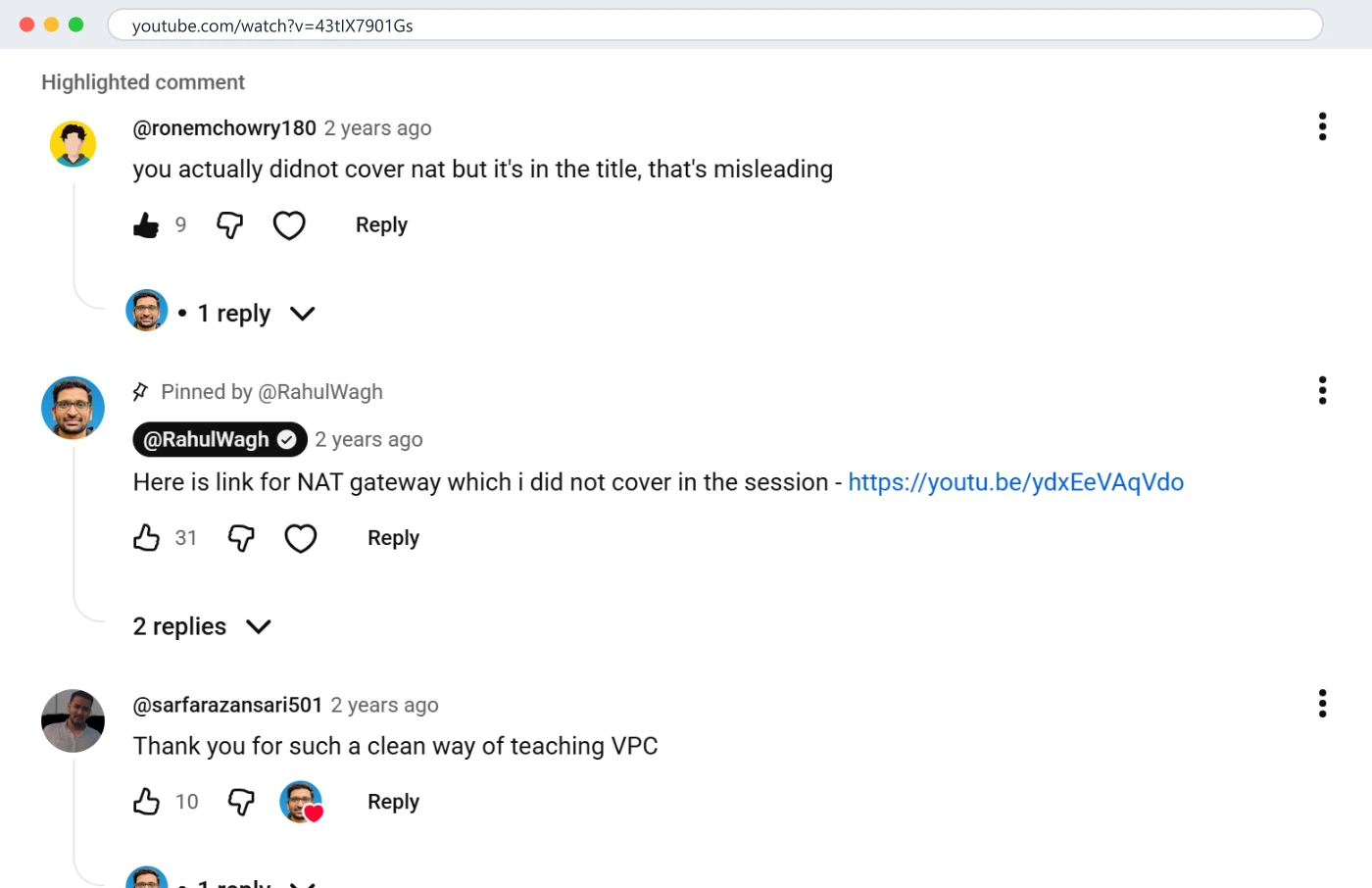
"You actually didnot cover nat but it's in the title, that's misleading." May 2024, under my VPC video, 9 likes, the most-liked critical comment on the channel. It stung because it was true. I had planned to cover NAT, ran long, cut it, and did not change the title. I replied the same day with the reason and the link to the separate NAT video I had made, and pinned a top-level comment with the same link. That pinned reply has 31 likes today, more than the complaint. The sting lasted a day; the fix has been working for two years.
The thread on my VPC video, 13 October 2026: the complaint at 9 likes, the pinned reply with the missing link at 31. The comment that hurt most produced the most useful thing on the page. Click to enlarge.
"It's too verbose. Can be cut down into 1 hour video. Anyways I got the required knowledge. Thanks." April 2024, Helm tutorial. This one bothered me out of proportion because it was polite. A five-hour course dismissed as padding by someone who then admits it worked. I replied "You're welcome! Thanks for the feedback" and left it. A different viewer that September said the opposite about the EC2 course, that five hours for EC2 alone was suspicious, and I told them I had been doing AWS for a decade and still did not feel done. You cannot win the length argument in the comments; you can only decide what the course is for.
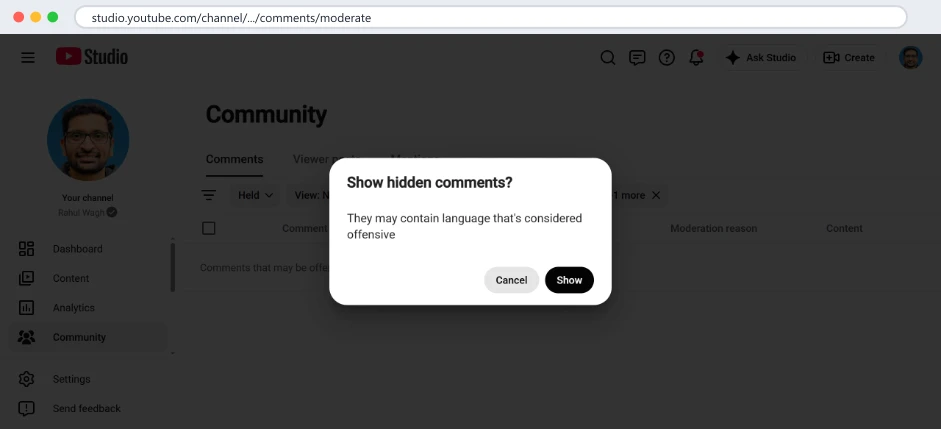
The September 2026 one. A viewer followed my AWS Organizations video, created an organisation on a free-tier account, got an email that the account was now paid, and came back to swear at me. YouTube's filter held it; I only saw it on 11 October while writing a different post, 26 days later, behind the two clicks of the Held view. The language was ugly and the point was fair: there should have been a warning. I did not approve it and I did not reply to it. On 12 October a different viewer asked the same question politely, and that one is the comment that gets the answer, in public, under the same video.
My Studio Held view, 11 October 2026. The one abusive comment of the month, held by the filter, behind a button and a confirmation. I read it once, took the point, and left it there.
What the three have in common: each was partly right. That is the pattern I have noticed over seven years. The comments that hurt are rarely the pure insults; those slide off. The ones that stay are the ones with a true thing inside them, said badly. Which means the way through is not to stop reading them. It is to get faster at separating the true thing from the way it was said.
What did the criticism actually say?
Since criticism is the category the anxiety is about, here is all of it from the export, every comment that criticised the video itself rather than asking a question. Eleven comments out of 964 matched the usual words (too long, boring, mic, misleading, not clear, not explained, quality); two of those were false matches (a viewer stuck on a Jenkins pipeline, and a compliment that used the word "confusing" about other people's videos). Nine real ones, across five videos and three years:
What they said, shortened
Video
What I did
Title promises NAT, video does not cover it, misleading
VPC
Replied with the reason and the link; pinned the link
Video quality is not 1080p, hard to see
EC2 course
Asked for the timestamp
Networking concepts not explained in enough detail for beginners
EC2 course
Linked the dedicated networking session
So boring and lengthy, and you do not use Kubernetes to scale like that
Helm
Left it; the second half was wrong and the first half is a matter of taste
Too verbose, could be one hour, got what I needed anyway
Helm
"You're welcome! Thanks for the feedback"
Beginning is not clear about which server is which
Ansible
Explained control node versus target in the reply; noted for the next video
You did not explain WSL issues and there is no link
Ansible
Said plainly that I do not have a Windows laptop to demonstrate it
Background sound is distracting
Ansible
Asked for the timestamp
Mic quality is bad
Ansible
Asked for the timestamp
Nine comments. Three about audio or video quality, three about length or pace, two about a missing topic, one about a confusing opening. Every one of them is about the work, not about me, and five of the nine led to something I could do. Written out like this it is a product review, and a fairly gentle one. Read one at a time, in a feed, each felt like a verdict.
That gap, between the table and the feeling, is the whole subject of this post. The table is what is true. The feeling is what one comment at a time does to a person who made the thing.
What I do with each kind of comment
A sorting rule turned the dread into a procedure. When I open a comment now, it goes into one of five buckets within a second, and each bucket has one move.
Thanks (one in three). One line back, varying the line. "You are welcome." "Glad it helped." "Good luck with the interview." Ten seconds. These are the comments that make the job pleasant, and an anxious reader skims past them looking for the attack.
Questions and errors (one in five). Answer or ask back. These are the reason the channel exists. A question answered in public is read by the next viewer with the same problem, and a good share of my video ideas came from here. Anxiety makes you avoid exactly the comments that are worth the most.
Criticism with a true thing inside (under one in fifty). Find the true thing, say it back plainly, fix what can be fixed, skip the rest. "You are right, the diagram says 12.0.1.0/16 and it should be 12.0.0.0/16; cannot edit a published video, noted for the next one." No defence, no apology paragraph. The viewer wanted to be right, and they were.
Criticism about production (audio, length, pace). Ask for the timestamp. "Can you point me at where the sound was bad?" Often there is no reply, and the ones who do reply give me something I can fix. It also converts the tone: a person asked to help usually helps.
Abuse with nothing inside (close to zero once the filter has done its work). Nothing. Not a reply, not a like, not a removal unless it contains a slur or a threat, in which case Remove, and Hide user if it is a repeat account. YouTube's Basic filter catches most of these before I see them; the Held view is where they wait, and I open it once a week on purpose rather than being ambushed by it.
The buckets matter more than the replies. Before I had them, every comment arrived as a potential attack to be braced for. Now the first second is a sort, and nine out of ten sorts land in a bucket that is pleasant or useful.
Why is not reading them worse?
There were years when I mostly did not read the comments; I wrote about them in I ignored my YouTube comments for years. The channel was growing, the day job was heavy, and every time I opened Studio the thing I noticed was the one critical comment, so I stopped opening it. Here is what that cost, from the same export.
The backlog. When I finally cleared the old comments on 27 and 28 September 2026 with the whole-channel inbox I had built, I posted 56 replies in two days, almost all on videos more than a year old, to questions that had been sitting there. Some of those viewers had long since solved it or gone. Every one of them had asked in public and watched nothing happen.
The misses. In the 964 comments, 33 mention the course or ask about buying. Several of those waited weeks for an answer. I do not know how many would have bought; I know the answer to "do you have a promo code" is one line.
The compounding. The question that nobody answers gets asked again next week, by the next viewer, who also gets no answer, and the comment section slowly turns into a wall of unanswered questions that tells every new viewer the creator is not home. On the 33 established channels I scanned on 6 October 2026, 75 percent of recent comments had no reply from the channel. I do not think most of those creators are lazy. I think a lot of them stopped opening the comments for the same reason I did.
The routine that made it a habit
What I actually do now, and have done since the backlog clear.
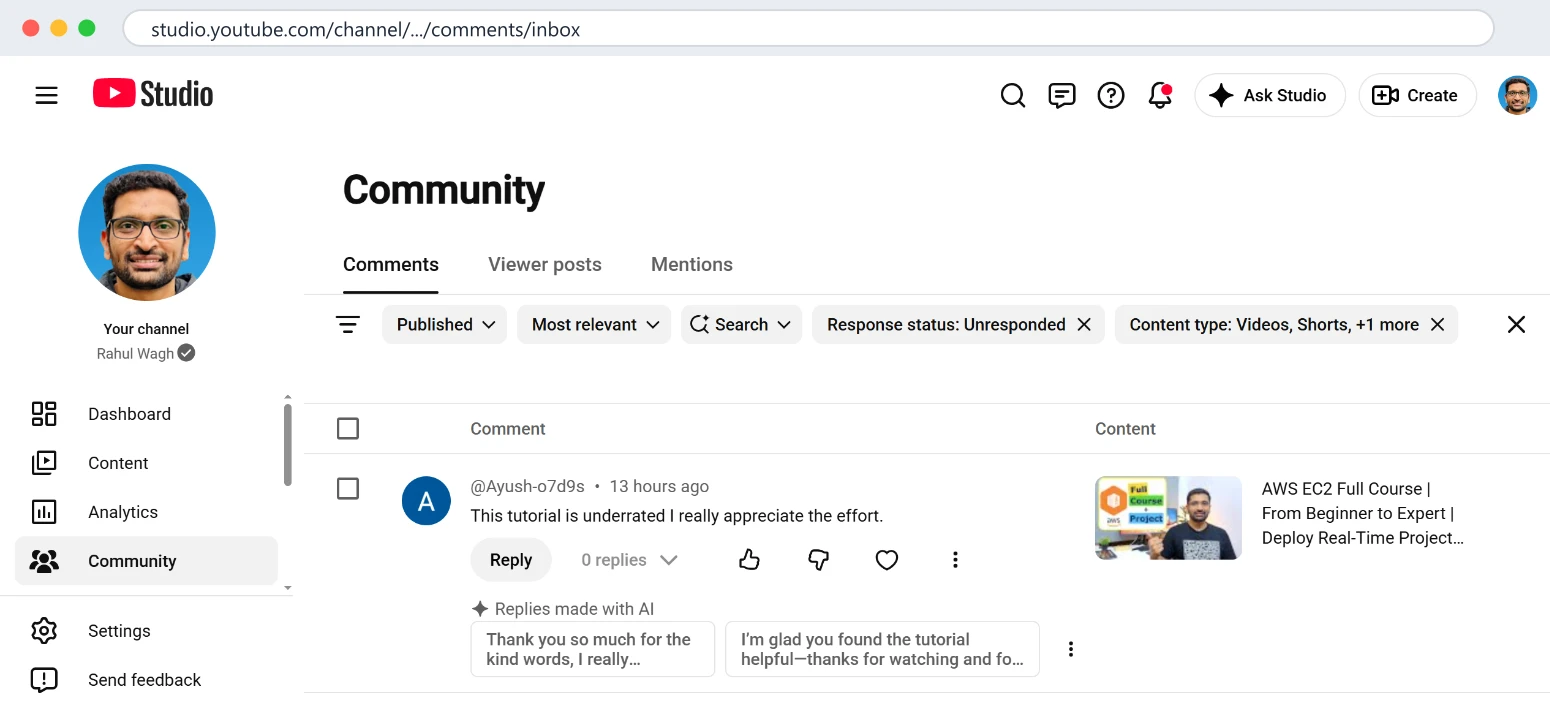
One list, newest first, once a day. In Studio that is Community with Response status set to Unresponded and the sort set to Newest; I use my own tool's inbox, which is the same idea across every video. The list is the whole job. There is no scrolling the video page looking for trouble.
My Studio inbox on 11 October 2026 with the Unresponded filter: one comment, 13 hours old. An empty or near-empty list is what the routine produces, and an empty list is a calm one.
Twenty to thirty minutes, on the phone, at a fixed time. Train or sofa for me. My advice is to avoid first thing in the morning, when a critical comment colours the day, and last thing at night. A fixed slot means I am not deciding whether to look; the deciding was the anxious part.
Questions first, thank-yous last. If time runs out, the thank-yous wait until tomorrow, and nobody has ever minded a thank-you answered a day late.
The Held view on Sunday, on purpose. Opening it deliberately, expecting the week's worst comment to be there, is entirely different from being surprised by it. Most Sundays it is empty.
Reply short. My median reply is 21 characters. A short reply is a complete reply, and short replies mean the list empties, and an empty list is the thing that quietly removes the dread.
Read the last 20 replies once a month, in a list. Not for the viewers; for me. It shows me whether I sounded like myself, and it is a record of a month of mostly pleasant exchanges that the anxious memory would otherwise delete.
When should you escalate instead of absorb?
Most of this post is about reading comments calmly. Some comments should not be read calmly; they should be dealt with, and YouTube gives you four levels. In order of force:
Remove a single comment. For a slur, a threat, or a scam link. The commenter is not notified.
Hide user from channel. Every future comment from that account disappears everywhere, including from your Studio, with no notice to them. For the second or third time from the same account. The list is in Settings, Community, and it is reversible.
Strict moderation for the channel, or a video. Holds more comments for review before they publish. For a period when something has gone wrong, a video that attracted a pile-on, or a topic that draws abuse. It also holds more real questions, so it is a dial to turn back down later.
Pause comments on a video. Keeps what is there, accepts nothing new. For a pile-on in progress. Turning comments Off entirely hides the existing ones too, which punishes the hundreds of people who said something kind.
The first two are for individual accounts, and on a tutorial channel they cover almost everything: scam links and the lookalike accounts that copy a creator's name. The last two are for a pile-on in progress, which a DevOps channel rarely sees and which your topic may see often. The point is to know the four levels exist before you need them, so that one abusive comment does not make you turn off the other 963.
I wrote about what each of those actions does to the viewer, and about the Held view where filtered comments wait, in YouTube comments held for review.
Does any of this apply if your channel is small?
Yes, differently. Under 50 comments a week the ratio is the same but the sample is small, so one bad comment is a bigger share of the week and lands harder; a week with ten thank-yous and one insult feels like an insult week. Two things help. Keep the exports; after three months you have a few hundred comments and the ratio becomes visible to you the way it is visible to me. And reply to the thank-yous, briefly, every one, because on a small channel those are the relationships the channel will be built on, and answering them puts your own words next to the insult on the page.
The other small-channel difference is that early comments are often from people you know, which is its own kind of anxiety. That passes. By a few thousand subscribers the commenters are strangers, and strangers are easier.
What this means for you
Count your comments once. Export a video, sort by type, and look at the ratio. The number of people attacking you is almost certainly under one percent, and knowing the number changes what you expect when you open the list.
Sort before you feel. Five buckets, one move each. The sorting is faster than the bracing.
The comment that hurts probably has a true thing in it. Find it, say it back, fix what you can. The rest of the comment is the viewer's problem.
Ask for the timestamp on production complaints. It turns an attacker into a tester.
Abuse with nothing inside gets nothing. Let the filter hold it, open the Held view on a schedule, and remove or hide what deserves it.
Not reading them does not protect you. It just moves the cost to the viewers, and then back to you as a backlog.
Fixed time, one list, newest first, short replies. The routine is the treatment.
Questions people ask
Should I turn off comments to protect my mental health?
If you are getting coordinated abuse, yes, temporarily; Pause keeps the old comments and accepts no new ones while you sort it out, and Strict moderation holds more. For ordinary criticism, no. Turning comments off removes the one in three that are thank-yous and the one in five that are questions to stop the one in two hundred. Moderation settings and the Held view are the proportionate tool.
Should I reply to hate comments?
To abuse with no question in it, no. To criticism, yes, briefly, in public, because the next viewer reads the exchange. I wrote about the line between them, with examples from my channel, in 40 real YouTube comment replies.
Why do the negative comments stick more than the positive ones?
Because they are rare and specific. A hundred "great video" comments blur into one; a single "misleading title" is a sentence you can quote a year later. The export is the antidote: it puts the hundred back next to the one.
What if the criticism is right?
Then it is free consulting. Say so in one line and fix it. The two most useful comments I have ever had were a diagram error and a missing-topic complaint, and both were written rudely.
How do I handle comments in languages I do not speak?
Reply in English, briefly, and assume good faith; most of the non-English comments on my channel are thanks or questions. The ones that are not get the same treatment as abuse in English: nothing.
Does the anxiety go away?
Mostly. What goes away is the bracing: the moment before opening the list. What stays is that a sharp comment still lands, for an hour or a day, when it has a true thing in it. I do not think that should go away; it is the part of you that cares whether the video was good. The routine is there so that the hour does not become a week of not looking.
What to do this week, no tool needed: export the comments of your most-viewed video, sort them into the five buckets, and count. Then open your Unresponded view at a fixed time each day for seven days and answer the questions first, in one line. By Sunday the list will be short, and the short list is the cure.
ReplyDial puts every unanswered comment across your channel in one list, newest first, so the daily pass is one screen instead of a hunt through video pages, and it posts only what you approve. The unanswered comments checker is free and shows how many comments on your channel are waiting, which is the number worth knowing before you open them.
See your own unanswered comments
ReplyDial lists every comment on your channel still waiting for a reply, drafts answers in your voice, and posts only what you approve. Free for 7 days on Creator limits, no card.
Yes, with four exceptions. What replying to every comment cost and returned on a 104k channel with a day job: 629 replies measured, 33 channels compared.
Every comment filter, queue and setting in YouTube Studio, with screenshots from my own 104k-subscriber channel taken this week: the Unresponded filter, the Held queue, blocked words, link holding, hidden users, AI reply suggestions, and the three things Studio still does not do for you.
How a 104k-subscriber creator sorts YouTube comments into answer, skip and report: YouTube Studio's own filters, what they miss, the comments that are not spam but not questions either, and the rule for replying without feeding the scammers.