Reply to YouTube comments within 24 hours: what it changed for me
On my channel the median reply now lands 1.6 hours after the comment and 74% of threads get one. What 24 hours means in the score, and 13 channels compared.
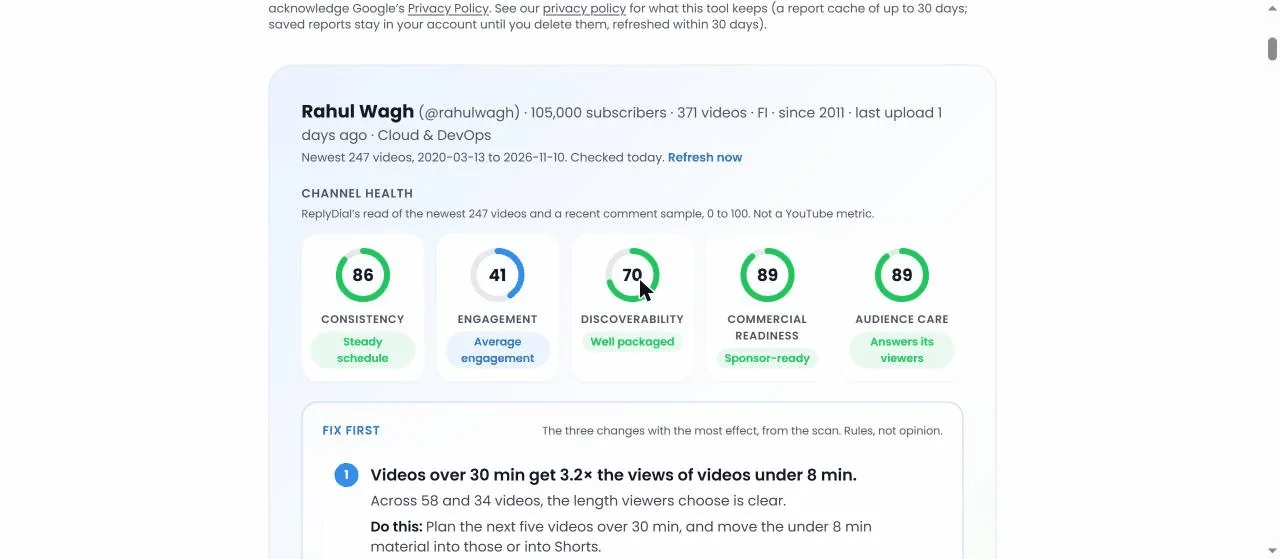
On 13 November 2026 I ran my own channel through the channel analyzer. The audience-care score came back 89 out of 100: on the newest five long videos it found 19 comment threads, I had answered 14 of them, and the median wait from a viewer's comment to my first reply was 1.6 hours. A month earlier, on 13 October, I had measured 629 of my own replies on my five most popular videos and the median wait was one day. The move from one day to under two hours is the change this post is about, and the 24-hour mark in the title is not a slogan: it is where the score's time points stop rising, so a reply at 1.6 hours and a reply at 23 hours are worth the same, and a reply at 63 hours is worth less.
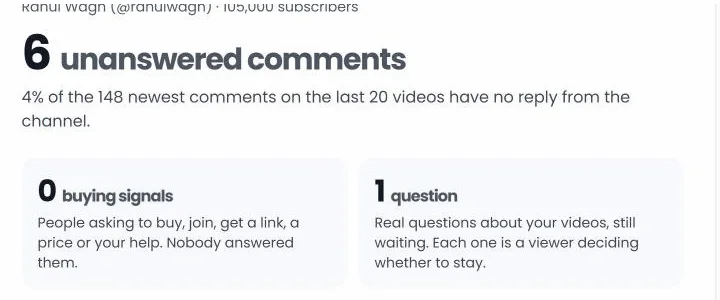
The honest part comes first. The two measurements are not the same sample: October was my five most-viewed videos, years old, with 1,599 threads; November was my five newest, with 19. The free checker on the same morning read 148 comments across my last 20 videos and found 6 with no reply, 5 of them under the video I had published the day before, and one real question that had been waiting three days. So "within 24 hours" on my channel is true for the videos I sat down with and false for the one I had not got to yet, and the tools show both.
My channel, measured on 13 Nov 2026
Value
Audience-care score (analyzer, newest 5 long videos)
89 of 100, "Answers its viewers"
Comment threads in the sample
19, of which 14 answered
Reply rate
74%
Median wait, comment to first reply
1.6 hours
Buying questions in the sample
0
Unanswered comments (checker, newest 148 comments on 20 videos)
6, which is 4%
Of those, under the video published the day before
5
Questions waiting
1, three days old
Same channel on 13 Oct 2026 (five most popular videos, 629 replies)
median wait 1 day, 291 replies the same day
My channel's five scores on 13 November 2026. Audience care, on the right, is the one this post is about: 40 points for the share of threads answered, 30 for the median wait, 30 for the buying questions answered.
What does "within 24 hours" mean in the score?
I wrote the audience-care score, so I can state the rule rather than guess at it. The analyzer takes the channel's newest long videos, up to five, and reads their comment threads, up to 100. For each thread it records whether the channel replied and how long the first reply took. Then:
40 points for reply rate: the share of sampled threads with a reply from the channel, times 40. Answer 74 percent and you have 29.6 points.
30 points for speed: the median wait over the answered threads. A median of 24 hours or less is the full 30. From there the points fall in a straight line to zero at 168 hours, one week. A 63-hour median is worth 21.9 points; a 25-hour median, 29.8.
30 points for buying questions: comments asking for a link, a price, a course, a job or help. The channel gets 30 times the share of those it answered. A sample with no buying questions gets the full 30, because there was nothing to miss.
A channel with fewer than 10 threads in the sample is "Too few comments" and gets no score, which is fairer than scoring it on three replies.
So 24 hours is the line because the time points max out there. I chose it, and the reason is practical rather than scientific: a viewer who comments is on the video today. They are deciding, today, whether this channel is one where a question gets an answer. A reply tomorrow still reaches them through the notification; a reply next week reaches the notification and not the person. The straight line to 168 hours is the rest of that thought: every day of delay costs about five points, until a week late is worth nothing.
My 89 is 29.6 for the rate, 30 for 1.6 hours, 30 for zero buying questions, rounded. The 11 points I lost are the 5 threads I had not answered, and 5 of those were under a video that was 1 day old when the sample was taken. The score does not know that; it reads what is there on the morning it runs.
How do 13 channels in my niche compare on speed and coverage?
Last week I opened the full reports of 13 Cloud & DevOps channels for the post on who sponsors them. Each report also has an audience-care sample, so here are all 13 on the two numbers that matter, from the same day, 13 November 2026. Two channels had fewer than 10 threads and got no score.
Channel
Subscribers
Threads sampled
Answered
Reply rate
Median wait
Questions answered
Score
Anton Putra
122K
37
31
84%
5.6 h
5 of 5
94
Rahul Wagh
105K
19
14
74%
1.6 h
none asked
89
tutoriaLinux
215K
42
17
40%
25.2 h
5 of 6
76
Tech Tutorials with Piyush
126K
38
10
26%
10.4 h
3 of 7
71
Christian Lempa
278K
105
40
38%
63.3 h
7 of 18
67
Abhishek.Veeramalla
678K
50
33
66%
0.4 h
12 of 18
66
DevOps Directive
107K
234
39
17%
3.7 h
12 of 31
44
Tech With Lucy
279K
40
11
28%
2.2 h
1 of 9
41
DevOps Toolbox
138K
242
37
15%
18.3 h
12 of 53
36
TechWorld with Nana
1.5M
229
21
9%
9.4 h
1 of 33
34
A Cloud Guru
142K
11
0
0%
no replies
0 of 4
30
Thetips4you
112K
2
1
50%
6.9 h
none asked
too few comments
Cloud With Raj
128K
9
2
22%
3.4 h
0 of 2
too few comments
Four things I read in that table, all of which changed how I think about the 24-hour rule.
Speed without coverage scores low. Abhishek.Veeramalla has the fastest median in the set, 24 minutes, and lands at 66, because a third of the threads got no reply and 6 of 18 questions were left open. Tech With Lucy answers in 2.2 hours and scores 41, because she answers 28 percent of threads and 1 of 9 questions. The time points are the easy 30: once you reply at all, replying the same day is a habit, not a cost. The rate points are where the work is.
Coverage without speed scores better than I expected. tutoriaLinux has not uploaded in over a year, but on its newest five videos it answered 40 percent of threads and 5 of 6 questions; the median wait was 25.2 hours, which costs 0.25 of a point. Score 76. The lesson is that an hour past the line costs almost nothing. The cliff is at a week, not at a day.
Big channels drown. TechWorld with Nana's five newest videos have 229 threads and 21 replies; DevOps Toolbox has 242 and 37; DevOps Directive 234 and 39. These are not creators who ignore comments, they are creators with 50 comments a video and a day job or a production schedule, and 9 to 17 percent is what "I reply when I can" produces at that volume. Nana answered 1 of 33 questions. The leads column on her report shows 5 buying questions and none answered, which is the 30 points that hurt most and the ones a brand or an agency reading the report will notice.
Anton Putra is what the rule looks like done well at my size. 37 threads, 31 answered, every question answered, 5.6 hours median. Score 94. He is not faster than me; he covers more. That is the whole argument for setting the bar at 24 hours rather than at one hour: it leaves room to answer everything.
What actually changed on my channel between October and November?
I want to be careful here, because the two measurements differ and I do not want to claim a result the data cannot carry.
What I can show from the October post is this. On 13 October 2026 I exported every reply I had posted under my five most popular videos, 629 replies across 1,599 threads, some of them years old. 291 replies went out the same day as the comment, and the median wait was 1 day. Before September 2026 my replies had a median length of 21 characters. Earlier still, on 1 October, I had written about finding 155 top-level comments on my channel with no reply, spread across three years, and answering them over two evenings.
What I can show from the November reports is this. On the newest five long videos, the median wait is 1.6 hours and 14 of 19 threads have a reply. On the newest 20 videos, 142 of 148 comments have a reply. The one question waiting is three days old, under the video announcing the Ansible course, and it asks whether Ansible is still worth learning. It was still waiting when I took the screenshot below, which is a sentence I would rather not have to write.
So the honest statement is narrower than "I now reply within 24 hours". It is: on the videos I have sat down with since September, the median wait went from a day to under two hours and the coverage went from "most, eventually" to 74 percent on the day of measurement and 96 percent across the last 20 videos. The videos I have not sat down with yet are the gap, and the gap is visible in the checker the morning after I publish.
Three things made the difference, and only one of them is a tool.
The first is a time of day. I read comments once in the morning, from my phone. Not when the notification arrives, because a notification arriving while I am at work gets dismissed and forgotten; that is the mechanism that produced 155 unanswered comments over three years. Once a day, same slot, is what puts the median at 1.6 hours for comments that arrive overnight in my time zone, which on a channel run from Finland is most of them.
The second is drafts I edit instead of replies I write. The reply-rate post has the cost model: three warm sentences per comment is eight hours a week at my volume, and that number is why creators stop. A drafted reply that I correct and approve is about 40 seconds, and the 14 October post measured the result: 487 of 629 replies under 80 characters, most of them a direct answer plus a thank-you. ReplyDial drafts them from the comment and the video; nothing is posted until I tap it, and the tap comes after a read. I will say plainly that this is my product and I built it because of the 155.
The third is a rule about order. Newest first. The checker sorts unanswered comments by video and the newest video is at the top because that is where the day-old comments are. If I answer the three-year-old comment first, I feel virtuous and the viewer who commented last night still has nothing. Answer everything from the last 24 hours, then go back as far as the morning allows.
The free checker the same morning: 6 of the 148 newest comments on my last 20 videos had no reply, and 5 of the 6 were under the video I had published the day before. The one question had waited three days.
What did the checker see, video by video?
The checker reads the newest comments on the last 20 videos, up to 148 that morning, and lists the ones with no reply from the channel. Here is the whole list from 13 November 2026, because the shape of it is the point: the unanswered comments are not scattered across the channel, they sit under one video.
Video (newest first)
Newest comments read
Unanswered
I Broke My AWS Deploy on Purpose. Ansible + AI Found the Bug
Stop Building Stateless AI Chatbots, Build a Durable Kubernetes Agent Instead
1
0
Reduce AI token count, do not pay for every conversation
2
0
I Trained an AI on 7,000 of My Own YouTube Comments with Crusoe
2
0
n8n Tutorial for Beginners, Complete Course
2
0
Google Cloud Shared VPC Explained, Part 14
9
0
Google Cloud VPC Peering Full Course, Part 13
5
0
I built an AI agent for $0/month (Short)
3
0
AWS Bedrock + Claude + MCP Server, Powered by Teleport (two uploads)
2 and 6
0
What is RAG? Build a Local AI Agent with LangChain + Ollama
23
0
Google Cloud DNS Full Course, Part 12
10
0
Google Cloud Network Load Balancer, Part 11
5
0
Claude vs ChatGPT vs Gemini: 5 Tests
7
0
What Happens When AI Runs Your Cloud?
9
0
I Told AI to Deploy My Cloud Infra. It Actually Did It
17
0
Google Cloud Internal Load Balancer, Part 10
10
0
Google Cloud External Load Balancer, Part 9
16
0
Eighteen of the twenty videos are at zero. The RAG tutorial has 23 recent comments and none waiting; the "I Told AI to Deploy My Cloud Infra" video has 17 and none. The video from the day before has 6 and 5 waiting, and the course announcement has the one question. That is what a once-a-day habit looks like from the outside: a clean back catalogue and a newest video that is always slightly behind, by exactly the hours between the upload and the next morning's slot.
It also shows why the checker and the analyzer disagree on the same morning. The analyzer sampled the five newest long videos and found 19 threads; the checker read up to the newest 20 comments on each of 20 videos and found 148. The analyzer's 74 percent is 14 of 19 on the five videos that happen to include the day-old one; the checker's 96 percent is 142 of 148 across four months. Both are right, and the second is the number I would show a sponsor, because it is the one that describes the channel rather than the week.
What does a 24-hour habit cost per week?
The reason most creators do not do this is time, so here is the arithmetic, using the per-reply figures I measured in the 14 October post: a written reply of three warm sentences takes about two and a half minutes; a one-line direct answer takes about 40 seconds; a drafted reply that you read, correct where needed and approve takes about the same 40 seconds, because the reading is the work and the typing was never the expensive part.
Comments a week
Three sentences each
One line each
Drafted and approved
20
50 min
13 min
13 min
50
2 h 5 min
33 min
33 min
100
4 h 10 min
1 h 7 min
1 h 7 min
200
8 h 20 min
2 h 13 min
2 h 13 min
My channel sits between the 20 and 50 rows most weeks, which is why the once-a-day slot is ten to fifteen minutes and why I can keep it. TechWorld with Nana's five newest videos had 229 threads; at her volume the top row of the table is a part-time job, and the table explains her 9 percent better than any judgement about caring does. The 24-hour rule is cheap at 50 comments a week and expensive at 500, and a creator at 500 should read the table and decide to answer the questions first, which is the 30 points the score weights for that reason.
Why 24 hours and not one hour, or one week?
One hour is a performance, and performances stop. The table above has channels that answer within minutes on the newest video and leave most threads open, which is what happens when a creator watches the launch and not the comments. That pattern produces a fast median on the newest video and a low reply rate everywhere else, which is the Tech With Lucy shape in the table above: fast, and 28 percent.
One week is where the viewer has gone. The notification will still be delivered, and the thread will still show the reply to the next person who reads the comments, which has its own value. But the person who asked has watched three other channels' answers by then. The score's straight line from 24 to 168 hours is my attempt to put a number on that decay without pretending to know it precisely: a reply on day two is worth about 25 of 30 points, day four about 15, day seven zero.
24 hours is a day, and a day is a unit a person with a job can commit to. "Once a day" survives a work trip, a sick child and a launch week. "Within the hour" does not. The score rewards the thing you can keep doing.
There is also a reason that has nothing to do with the score. The comments that arrive in the first day under a new video are disproportionately the useful ones: the question about the step that did not work, the request for the next topic, the correction. On my channel those are where the video ideas come from. In the 1 October post I counted at least a handful of the 155 ignored comments as videos I should have made a year earlier. A reply within the day is also a read within the day, and reading is where the value is.
What broke, and what the measurements cannot see
The sample is five videos. On a channel that uploads three times a month, five newest long videos is about seven weeks. On a channel that uploads 17 times a month, it is nine days. The two scores are not measuring the same stretch of time, and a creator who had a bad week scores it until the next five uploads push it out. The reply-rate post has a longer discussion of why I kept five anyway: it is the stretch a viewer sees when they arrive.
"Answered" means a reply from the channel, any reply. A heart is not a reply. A reply from a moderator account is not a reply from the channel. A pinned comment from the creator is not a reply to anyone. All three are things creators do instead of replying, and the score does not count them, by design, and some creators will feel that is unfair. I think a viewer who asked a question and got a heart would agree with the score.
Median hides the tail. My 1.6 hours is the middle of 14 answered threads. The three-day question is not in that number because it was not answered when the sample ran. A median of 1.6 hours and a question waiting three days are both true of the same channel on the same morning, and a creator who only looks at the first one will not see the second. That is why the checker exists next to the analyzer: one scores, the other lists.
The 5 unanswered under the new video are the method working, not failing. Comments under a video published on 12 November, read on the morning of 13 November, had not had their once-a-day slot yet. But the checker took its reading at 06:00 UTC, and 06:00 UTC is before my coffee, so the honest number for that morning is 6, not 1.
And none of this is YouTube's metric. The scores are ReplyDial's read of public numbers. YouTube does not publish a reply rate or a response time, and the API does not say whether a late reply reaches anyone. If a creator tells you replying within 24 hours lifts their views, ask them how they measured it; I cannot measure it on my channel either. What I can measure is that the comments get answered, the questions become videos, and the people asking stay in the thread. The 14 October post has what I can and cannot prove about the rest.
What to do this week
Pick one slot a day, the same one every day, and answer every comment from the last 24 hours before you touch anything older; on day seven, run the free checker on your handle and see whether the count under your newest video is zero.
If you want the once-a-day slot to take ten minutes instead of an hour, ReplyDial's inbox puts every unanswered comment across the channel in one list, newest first, with a drafted reply you edit and approve; the channel analyzer scores the result the way this post describes, and both are free for the first 7 days of any account, with the plans on the pricing page.
See your own unanswered comments
ReplyDial lists every comment on your channel still waiting for a reply, drafts answers in your voice, and posts only what you approve. Free for 7 days on Creator limits, no card.
Reply rate is the share of comment threads the channel answered. How to count it from public data, what 8 channels scored, and why the buying questions matter.
Studio's Response status: Unresponded filter lists the comments you never answered. What it counts, what it misses, and my channel's numbers on 9 November 2026.
Six places YouTube comments hide: the Held filter, Most relevant sort, follow-ups in answered threads, the bell, Shorts and posts, old videos. My 104k channel.