How to find Personal finance YouTube channels that take sponsors
Discover on 9 Nov 2026: 263 Personal finance channels in the inventory, 6 with a full report, 4 with sponsors. Who they are, who paid them, why four is honest.
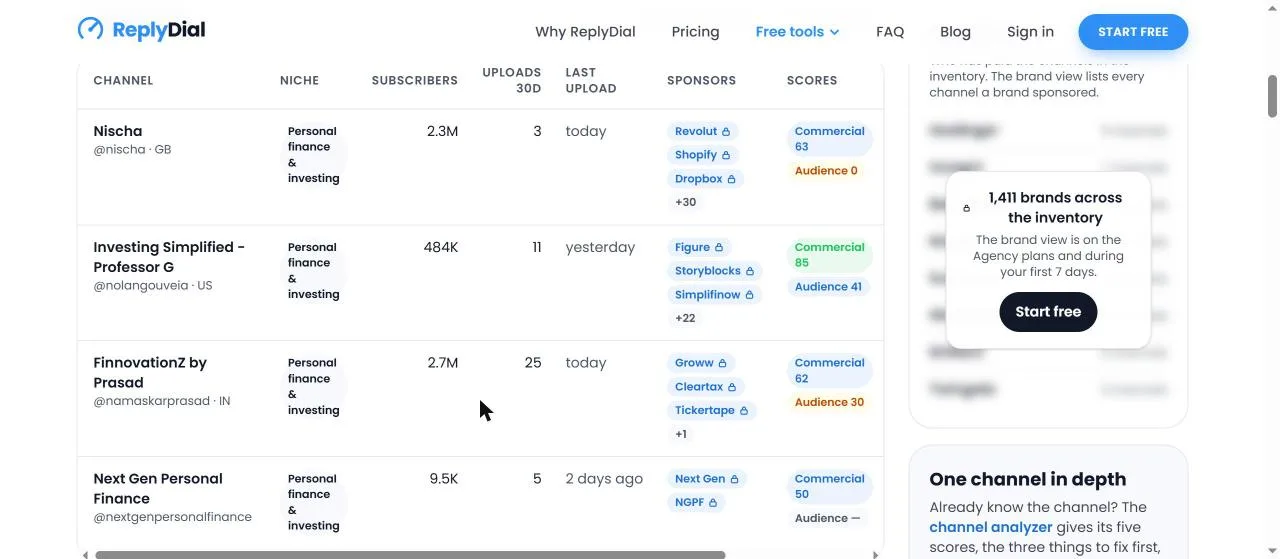
On 9 November 2026 I opened Discover, set the niche to Personal finance & investing, ticked "Has sponsors" and sorted by most sponsors. Four channels came back: Nischa (2.3 million subscribers, 33 sponsoring brands), Investing Simplified with Professor G (484,000 subscribers, 25 brands), FinnovationZ by Prasad (2.7 million subscribers, 4 brands) and Next Gen Personal Finance (9,500 subscribers, 2 brands). The same niche without the sponsor filter holds 263 channels. Of those 263, exactly 6 have been run through the full report, and 4 of the 6 have at least one sponsor at high or medium confidence. That is the whole result, and the gap between 263 and 4 is the useful part of this post.
I built Discover, so I will not dress the number up. The 257 channels without a report are rows that arrived through a YouTube keyword search: a name, a subscriber count, a country and YouTube's topic tags, nothing about sponsors until somebody opens the report. The 4 that do show sponsors are the ones someone analysed, and their sponsor lists are the part a brand or an agency can act on today. Below is what each row says, brand by brand with dates and evidence, what changed in the niche filter the same morning (it used to return channels from other niches, and I fixed it), how to read a sponsor list without being fooled by the noise in it, and what to do with four rows when you wanted forty.
Search on 9 Nov 2026, Discover
Result
Niche: Personal finance & investing, no other filter
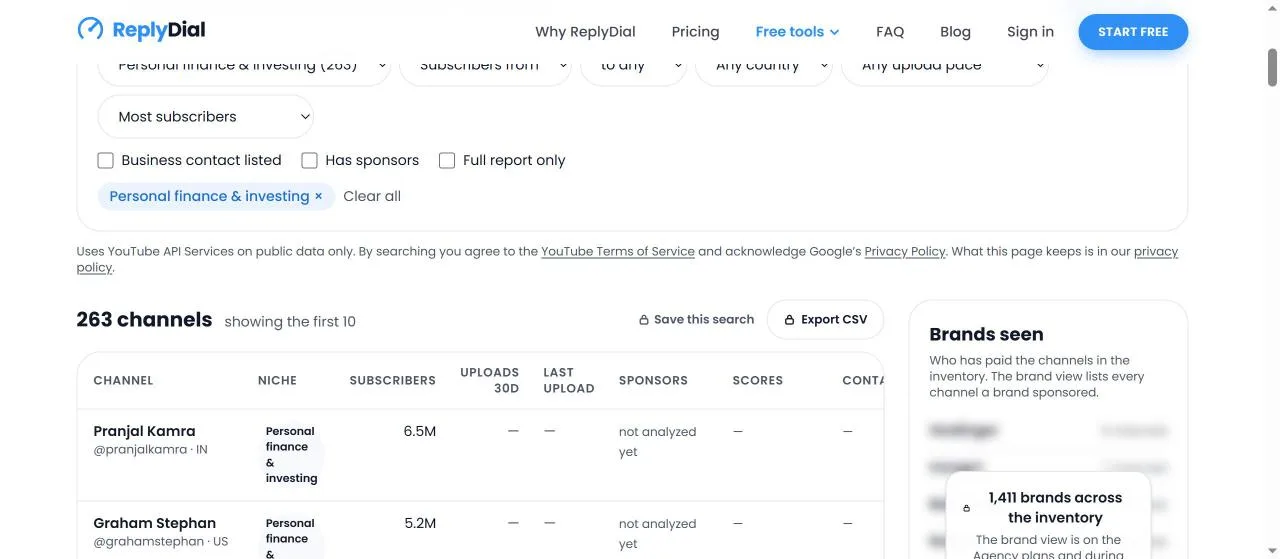
263 channels, first 10 shown without sign-in
Same niche, "Full report only"
6 channels
Same niche, "Has sponsors", sorted by most sponsors
4 channels
Whole inventory, for scale
2,828 channels, 174 with a full report, 1,411 sponsoring brands seen
Niche before the morning's fix, "Has sponsors"
11 rows, only 3 with Personal finance as their main niche
The search that this post is about. Four rows, each with its first three sponsors, its uploads in the last 30 days, its last upload and two of its five scores. The lock on each brand chip is the brand view, which is on the Agency plans.
What did the search return, row by row?
The result table shows each channel's first three brands, the count of the rest, uploads in the last 30 days, the date of the last upload, the Commercial readiness and Audience care scores, and whether a business contact is listed in a description. Here are the four rows as they stood on the afternoon of 9 November 2026, with the numbers taken from the full reports behind them.
Channel
Subscribers
Country
Sponsors (high + medium)
Returning brands
Uploads, 30 days
Commercial
Audience care
Contact listed
Nischa, @nischa
2,270,000
GB
33
10
3
63, Partly ready
0
no
Investing Simplified, @nolangouveia
484,000
US
25
13
11
85, Sponsor-ready
41
yes
FinnovationZ by Prasad, @namaskarprasad
2,680,000
IN
4
0
25
62, Partly ready
30
yes
Next Gen Personal Finance, @nextgenpersonalfinance
9,500
not set
2
not shown
5
50
no sample
no
Two things stand out before any brand name. The biggest channel of the four has the fewest sponsors per video, and the smallest channel by far (484,000 subscribers against millions) has the highest Commercial readiness, 85, because it does the four things the score rewards: a listed contact, sponsors, brands that came back, and products of its own. Subscriber count and sponsor readiness are different axes. An agency that sorts by subscribers alone would put FinnovationZ first and Professor G last, and would have it backwards for a sponsorship brief.
The fourth row, Next Gen Personal Finance, is a nonprofit curriculum publisher whose two "sponsors" are its own names, Next Gen and NGPF, picked up from its own links on videos it marked as paid promotion. That is a true positive by the rule (the paid-promotion flag plus a linked domain) and a false positive by common sense. I leave it in because the tool left it in, and because it shows how the medium-confidence rule behaves. More on that in the section on reading a sponsor list.
Why do only four of 263 channels show sponsors?
Discover is not a crawl of YouTube. It is an inventory of two kinds of rows. The first kind is a channel somebody ran through the channel analyzer: the report reads the newest 300 videos through the public YouTube Data API, finds disclosed sponsors in descriptions, reads YouTube's paid-promotion flag, counts links, and leaves one row in Discover with size, country, niche, posting pace, sponsors and two scores. The second kind is a channel that arrived through a keyword search: when the inventory has nothing for a keyword, Discover asks YouTube once and stores up to 50 channels as "not analyzed yet", with the name, subscriber count, country and YouTube's own topic tags, and nothing else.
Personal finance & investing had 263 rows on 9 November 2026 and only 6 reports. The other 257 came from keyword searches by visitors over the past 30 days (rows older than 30 days without a report are deleted, so the inventory is always recent). Those rows cannot show sponsors because nobody has read their descriptions yet. The "Has sponsors" filter therefore does not mean "the four finance channels on YouTube with sponsors". It means "the four finance channels in this inventory whose newest 300 videos have been read and contained a sponsor at high or medium confidence". If you want the list to be longer, the fix is one click per row: the Analyze button on any "not analyzed yet" row runs the report and the row fills in. On the first page of the niche alone there are six such rows worth running, from 6.5 million subscribers down to 1.5 million.
The six channels with a report are the four above plus Groww, a broker that publishes 42 videos a month and shows "none found" for sponsors (a brand does not sponsor itself, and the report found no third-party disclosure), and School of Personal Finance, also with none found. So the honest sentence is: of the six Personal finance channels anyone has analysed, four take sponsors, one is a brand's own channel, and one has no sponsor in its newest 300 videos.
The same niche without the sponsor filter: 263 channels, the first 10 free. The two biggest rows, Pranjal Kamra and Graham Stephan, are not analyzed yet, so their sponsor columns are empty until someone clicks Analyze.
Who paid the three channels with real sponsor lists?
Each report lists every brand with a confidence level, how many videos it appeared in, the first and last dates, and the evidence. I pulled the three lists on 9 November 2026. The Nischa and FinnovationZ reports were fresh scans that afternoon; the Professor G report had been run at 10:36 UTC the same morning and was served from the database.
Nischa, 33 brands at high or medium confidence, 10 of them returning. Her channel has 284 videos in total and the report read all of them, from December 2021 to 8 November 2026, so the dates here span her whole channel rather than a 300-video window. 176 of the 284 videos are sponsored by the report's definition; 171 disclose a sponsor in the description and 96 carry YouTube's paid-promotion label. The six high-confidence brands, each disclosed in the description and labelled, are Revolut (6 videos, December 2023 to April 2026), Shopify (4 videos, August to October 2026), Dropbox (3, March 2024 to July 2025), Huel (3, February to July 2023), Paperlike (1, November 2023) and CleanMyMac (1, September 2023). The medium-confidence list is longer: Skillshare 5 videos across 2024, Grammarly 4 videos in 2024, Fiverr 3 videos in late 2025, and about two dozen single-video brands including Wise, Plaud, Hostinger, Ikea and Nikkei. She sells a newsletter, a course, coaching and affiliate links, so the Commercial score credits her 15 points for products. She loses 25 because no business contact is listed in any description, and the label check gives her 13 of 25 because 91 of the 171 disclosed videos carry the label. Her Audience care score is 0: of the last 416 comments sampled, 416 had no reply from the channel.
Investing Simplified with Professor G, 25 brands, 13 returning. The report read the newest 300 of his 886 videos, from October 2024 to 7 November 2026. 256 of the 300 disclose a sponsor, and 30 of his last 30 long-form videos are sponsored: this is a channel where the integration is part of the format. The two high-confidence brands are Figure (2 videos, December 2025 and January 2026) and Storyblocks (1, November 2025). At medium confidence the returning brands are the interesting ones for a competitor check: Simplifinow, 9 videos between 17 October and 7 November 2026, so a current deal; 21shares, 8 videos spread over eight months from October 2025 to October 2026; Snowball Analytics, 7 videos over seven months; Growthschool, 5 videos; Nexo, Strawberry, Drinktrade and Quadratic, 3 each; Holafly, Sintra, Webull and Cashflow Empire, 2 each. The single-video names include Incogni, Surfshark, Proton and AG1, the brands that sponsor half of YouTube. His report's first commercial fix is that 152 sponsored videos lack YouTube's paid-promotion label: 104 of the 256 disclosed videos carry it, which is why the label check gives him 10 points of 25 and his score is 85 rather than 100. He lists a business contact, so he gets the 25 points Nischa does not.
FinnovationZ by Prasad, 4 brands, none returning. 1,837 videos in total, the newest 300 read, from August 2025 to 8 November 2026. He posts 25 videos a month and only 16 of the 300 are sponsored, 13 disclosed in the description and 4 labelled. The brands are Groww (1 video, June 2026, disclosed in the description, high confidence), Cleartax (3 videos in September 2025, found through a link repeated on sponsored videos), Tickertape (1, September 2026) and Sahi (1, May 2026). Only 1 of the 13 disclosed videos carries the label, so the label check gives him 2 points of 25, and with no returning brand he misses another 15. His report's first non-comment fix is on discoverability, not commerce: 176 of 300 videos have no tags, and his discoverability score is 35, "Hard to find". For a brand, the useful reading is that sponsorship is occasional on this channel and the three brokers that have bought are Indian retail-investing platforms.
Brand
Channel
Videos
First
Last
Evidence
Revolut
Nischa
6
Dec 2023
Apr 2026
disclosed in description + paid-promotion flag
Shopify
Nischa
4
Aug 2026
Oct 2026
disclosed + flag
Skillshare
Nischa
5
Jun 2024
Nov 2024
flag with the brand's link
Simplifinow
Professor G
9
Oct 2026
Nov 2026
link on sponsored videos + flag
21shares
Professor G
8
Oct 2025
Oct 2026
flag with the brand's link
Snowball Analytics
Professor G
7
Jan 2025
May 2026
flag with the brand's link
Figure
Professor G
2
Dec 2025
Jan 2026
disclosed + flag
Cleartax
FinnovationZ
3
Sep 2025
Sep 2025
link on sponsored videos
Groww
FinnovationZ
1
Jun 2026
Jun 2026
disclosed in description
The pattern across the three is the one I see in most niches: a few brands that came back three to nine times, and a long tail of single-video deals. The returning brands are the ones that tell a competitor something ("Revolut has bought six integrations on this channel across two and a half years"), and the single-video names tell you the channel is open to one-off deals at all.
How do you read a sponsor list without being fooled?
Sponsor detection from public data has three honest confidence levels and some noise, and I would rather you know the rules than trust the chips.
High confidence means the description names the brand as a sponsor ("this video is sponsored by", "thanks to X for sponsoring", a disclosure line) and the video also carries YouTube's paid-promotion flag. When both agree, the brand paid. All six of Nischa's high-confidence brands and both of Professor G's meet this test.
Medium confidence means one of two things: the video carries the paid-promotion flag and a link in the description points at the brand's domain, or the same domain is linked on several videos that are marked sponsored. This catches the majority of real deals, because most creators link the sponsor without writing the word "sponsored". It also produces the noise. On Nischa's list the medium tier includes "Gov", "Wi", "Ncesc", "Partnerlinks" and "Apa", which are not brands. They are domains that appeared in the description of a labelled video: a government page, a Wikipedia link, a statistics source, an affiliate-link host, a style guide. The report shows the example video for each, so you can see in ten seconds that Nischa did not take money from the American Psychological Association. The Discover row counts them in the "+30" because the row counts high plus medium, and I have not found a rule that drops them without also dropping real brands with odd domain names.
Low confidence is a link seen once on a sponsored video without the flag or a disclosure. The report shows it and the Discover count excludes it. Nischa has 4 such names and Professor G has 2; they are not in the 33 and the 25.
The paid-promotion label itself deserves a word, because two of these three channels are under-labelled. YouTube's "includes paid promotion" label is a tick box in Studio that the creator sets per video, and it is the disclosure that regulators and most brand contracts ask for. Nischa labels 91 of 171 disclosed videos, Professor G labels 104 of 256, FinnovationZ labels 1 of 13. A brand that cares about compliance should read those ratios, not only the sponsor count. I wrote a longer explanation of what the label does and does not mean in what the "includes paid promotion" label means, and the vetting steps a brand should run before signing are in the vetting checklist.
What changed in the niche filter on 9 November 2026?
I have to own a bug, because this search gave a different answer before lunch than after.
Every analysed channel carries a list of niches with a share for each, from a keyword match over its videos plus YouTube's topic tags. Nischa is 77 percent Personal finance & investing, 18 percent Self-improvement and 11 percent Business & marketing. Professor G is 97 percent Personal finance and 63 percent Tech reviews, because he talks about AI stocks and the tools he uses. Until the morning of 9 November 2026, the niche filter matched a channel if the chosen niche appeared anywhere in that list, at any share. So a search for Business & marketing returned Nischa, a search for Tech reviews returned Professor G, and a search for Personal finance with "Has sponsors" returned 11 rows, of which only 3 had Personal finance as their main niche; the other 8 were business, self-improvement and tech channels that mention money. I noticed it while preparing a Fitness & health search and finding channels from other niches in it.
The fix, live since the release that carried this post, is that the niche filter means the channel's main niche, the one with the highest share. The same search now returns 4 rows, all with Personal finance & investing as their first niche, and the count beside each niche in the dropdown, 263 for this one, is computed the same way, so the dropdown and the results agree. The cost of the fix is that a channel which is 45 percent finance and 50 percent self-improvement no longer appears in a finance search. I think that is the right trade: an agency filtering by niche wants channels whose audience came for that topic, and a secondary 11 percent share is not that. If you want the wider net, type the niche as a keyword in the search box instead of choosing it in the dropdown; the keyword search matches topics and video text, not the main niche.
How would an agency, a brand or a creator use four rows?
Four rows is not a shortlist, but it is a starting method, and the method scales to the 257 rows waiting.
An agency with a fintech brief. Sort by Commercial readiness rather than subscribers. Professor G at 85 is the row that answers a brief fastest: a listed contact, 13 brands that came back, 11 uploads a month, and a current deal with Simplifinow that tells you his rate card has a recent anchor. Open the report, read the 25 brands for your client's competitors (21shares and Nexo are both crypto investment products, Webull is a broker), and if none conflicts, the contact is on the report, as the creator wrote it. Then click Analyze on Graham Stephan and Pranjal Kamra, the two biggest unanalysed rows, because a finance brief without them is incomplete, and each report takes about 20 seconds and a few API units.
A brand doing a competitor check. The question is not "who has sponsors" but "has my competitor bought here, and when". The brand view, which lists every channel a given brand sponsored with the videos and dates, is on the Agency plans and during the first 7 days of any account. Without it, the three reports above already answer the question for Revolut (Nischa, 6 videos to April 2026), Wise (Nischa, 1 video, April 2026) and Webull (Professor G, 2 videos, early 2026). A UK neobank reading that Revolut bought six integrations across two and a half years on Nischa, and that Wise bought one in the same month as Revolut's last, has learned something about where the audience is.
A creator in the niche. Find the channels one step bigger than you and read their sponsors; those brands already pay for your audience. A finance creator with 50,000 subscribers should read Professor G's list, not Nischa's, because the brands sponsoring a 484,000-subscriber channel 30 videos in a row are buying in volume and will take a smaller channel's pitch. The example video on each brand's row shows what the integration looked like, so the pitch can say "like your spot on Investing Simplified in October, with my audience's numbers". The report also shows what the bigger channel sells (a newsletter, a course, a community), which is the other half of a finance creator's revenue.
What does the result table hide, and what does Discover not know?
A few things are deliberately not on the page, and a few things the data cannot see.
The Contact column says "listed" or "not listed". It does not show the address. The contact itself is on the full report and on the channel's own About page, and Discover stores none of it; two of these four channels list one, two do not. Nothing adds up across channels: there is no "total reach of the four" number, because the YouTube API terms do not allow aggregating channel metrics, and because such a number would be meaningless with a 9,500-subscriber row next to a 2.7 million one. There are no earnings, no RPM, no estimated rates: the public API does not return revenue and I will not guess at it. Audience demographics and watch time are private to the creator in Studio and are not in any report.
The sponsor detection reads descriptions and the paid-promotion flag. It does not watch the video, so a verbal-only integration with no link and no flag is invisible to it. It does not read pinned comments. It reads the newest 300 videos, so on a channel with 1,837 videos like FinnovationZ the list covers 15 months, and on Nischa's 284 it covers everything. And the niches are inferred from topics and video text, so a classification error is possible; on the first page of the 263 I can see at least two rows, a home-renovation channel and a manufacturing channel, that YouTube's topic tags filed under finance and that a report would most likely move. I would rather show you that than hide the rows.
Finally, the free tier shows the first 10 rows of every search, every column, and opens any report. A free account shows all 263 with paging and adds "Similar" on any row; the Agency plan at 79 dollars a month adds the brand view, 100 fresh reports a day, campaigns and CSV export. None of that changes the data; it changes how much of the list you can see at once.
What to do this week
If you are shortlisting finance channels for a sponsorship, run the search yourself on Discover with Personal finance & investing, "Has sponsors", sorted by most sponsors, then click Analyze on the two or three biggest "not analyzed yet" rows on the first page; each takes about 20 seconds and the sponsor column fills in for everyone who searches after you. Open the report of the one row whose Commercial readiness is highest, read its returning brands for your competitors, and check its paid-promotion label ratio before you write to it. If you are a finance creator, read the sponsor list of the channel one step above you and write to the brands that came back more than twice. ReplyDial is the free channel analyzer and Discover behind these numbers, plus a comment inbox for creators who want every comment answered; the four rows in this post are on the live page today, and the fifth, this week, will be whoever you analyse next.
See your own unanswered comments
ReplyDial lists every comment on your channel still waiting for a reply, drafts answers in your voice, and posts only what you approve. Free for 7 days on Creator limits, no card.
13 Cloud & DevOps channel reports, 13 Nov 2026: 141 brands, 19 on two or more channels. Kestra, Hostinger, Warp, Oracle, AWS and Coder lead; dates and videos.
14 channels in ReplyDial's inventory carry a Hostinger sponsorship: 48 videos, Aug 2022 to Aug 2026, nine channels first bought since Nov 2025. Every row dated.