How-to
YouTube comments held for review: what it means and what to do
Held for review on YouTube, from a real channel: what Basic and Strict hold, where held comments sit, the 60-day deadline, what the four buttons do.
17 October 2026 · 16 min read
Blog · How-to
YouTube's own FAQ lists what its recommendations watch, and comments are not on it. What that means, what comments do instead, and what 629 replies show.
By Rahul Wagh·· 16 min read
Probably a little, and nobody outside YouTube can tell you how much. YouTube's own help page lists what its recommendation system pays attention to: what viewers watch, what they do not watch, what they search for, likes and dislikes, and "not interested" feedback. Comments are not on that list. The same page says likes and dislikes count "somewhat", as "some of the hundreds of signals", and that the system mainly learns from whether people choose to watch, how much they watch, and whether they are satisfied. If comments are a signal, they are one of the hundreds, and a weak one next to watch time.
So the honest answer to "do comments help the algorithm" is: do not reply to comments for the algorithm. Reply for the three things comments measurably do, which I can show from my own channel: they turn into watch time on other videos through links and answered questions, they tell you what to make next, and they are the public record of whether anyone is home. I run a 104,000-subscriber DevOps tutorial channel and have answered comments on it for nearly seven years; this post is what YouTube has actually said, as of 17 October 2026, and what my own data can and cannot show.
From the "YouTube performance FAQ and troubleshooting" help page, under "How does YouTube choose what videos to promote?":
Our recommendation system narrows down the best set of videos to offer your audience by paying attention to: What they watch. What they don't watch. What they search for. Likes and dislikes. 'Not interested' feedback.
And under "Do likes/dislikes impact how my video is recommended?":
Somewhat. Likes and dislikes are some of the hundreds of signals we consider for ranking. Our recommendation system learns from whether or not viewers are choosing to watch a video. The system learns how much of the video the viewer watches and if they're satisfied. Your overall video performance is decided by a combination of these factors.
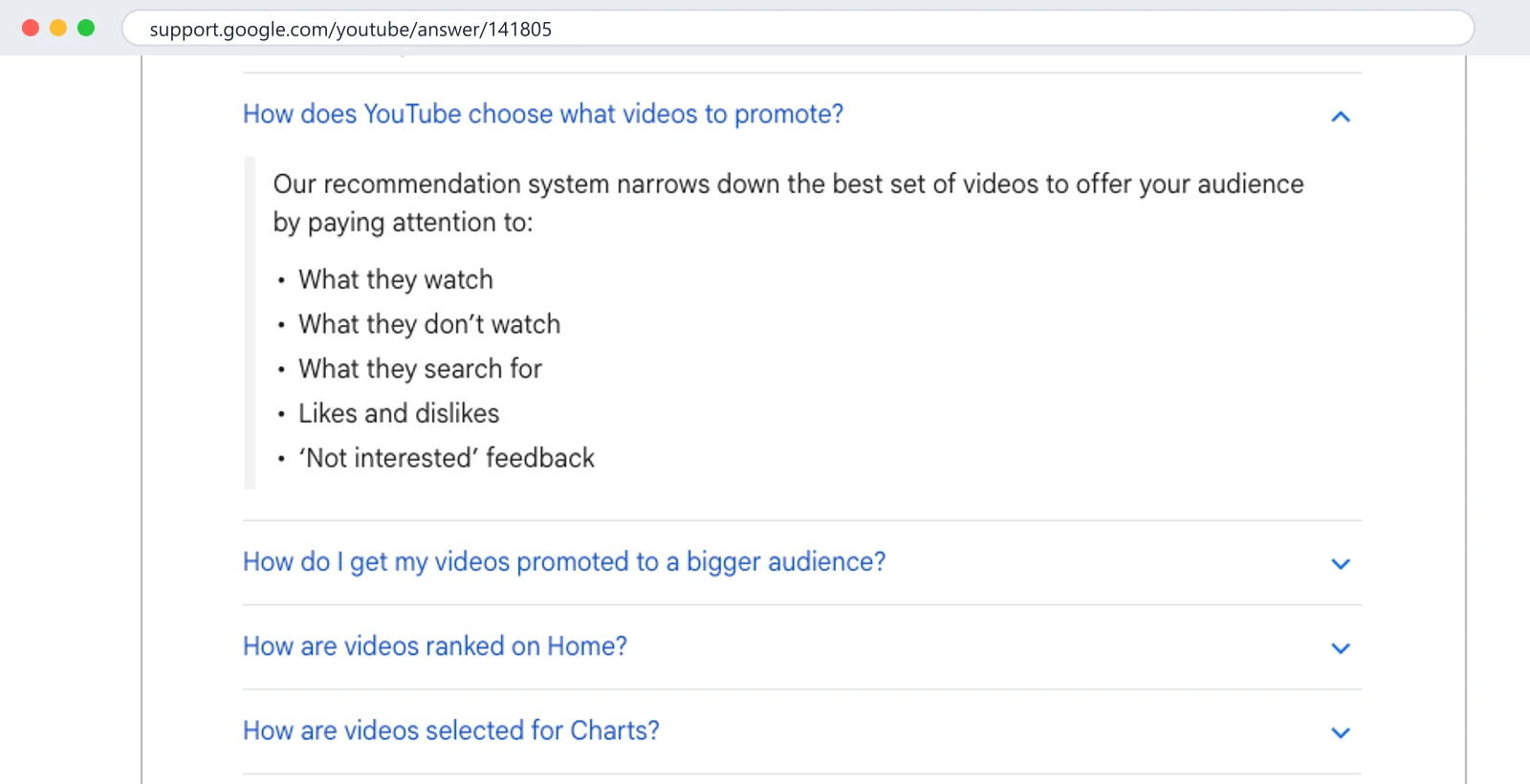
Read that carefully. The page that exists to answer "how do I get promoted" names five inputs and does not mention comments, replies, or comment counts. It then downgrades likes, which are a lighter action than commenting, to "somewhat" and "some of the hundreds of signals". The system is described as learning from viewing behaviour and satisfaction, which YouTube measures with surveys and watch patterns, not with the comment box.
That is not the same as "comments do nothing". A video with a lively comment section probably correlates with satisfied viewers, and satisfaction is a signal. But correlation is not a lever. You cannot make a video more satisfying by replying to its comments after the fact, and YouTube's wording gives you no reason to believe reply count is read at all.
The same FAQ page answers the three placements separately, and each answer is worth reading with the word "comments" in mind, because it is absent from all three.
On Home, from the page:
The selection of videos is based on: Performance, how well your video has interested and satisfied similar viewers, among other factors. Watch and search history, how often your audience watches a channel or topic and how many times we've already shown each video.
On Suggested, the "Up next" column:
Suggested Videos are ranked to offer your audience videos they're most likely to watch next. These videos are often related to the video your audience is watching, but they can also be personalized based on watch history.
On Search:
Like Google's search engine, YouTube search strives to surface the most relevant results according to keyword searches. Videos are ranked based on the following factors: How well the title, description, and video content match the viewer's search. What videos drive the most engagement for a search.
And the sentence that reframes the whole question, from "How do I get my videos promoted to a bigger audience?":
Our recommendation system doesn't promote videos to your audience but rather finds videos for your audience when they visit YouTube. Videos are ranked based on their performance and relevance to your audience.
Search is the one place where "engagement" appears, and it is "what videos drive the most engagement for a search", which in YouTube's own vocabulary elsewhere on the page means choosing to watch, how long, and satisfaction. It could include comments; the page does not say so, and it does say what it means by performance everywhere else. I take it as: a video that people click from a search and keep watching ranks for that search. Comments on it are a by-product of that, not the cause.
| Placement | What YouTube says it ranks on | Comments mentioned? |
|---|---|---|
| Home | Performance (interested and satisfied similar viewers), watch and search history, how often already shown | No |
| Suggested | Likelihood to watch next, relation to the current video, watch history | No |
| Search | Match of title, description and content to the query; engagement for that search | Not by name |
| General | What they watch, do not watch, search for; likes and dislikes; not interested | No |
Four answers, zero mentions. A creator reading that page should conclude that the ranking case for comments rests entirely on "engagement" in the search answer, which YouTube defines elsewhere as watching. That is a thin reed to hang 2.5 hours a week on, which is why the reasons later in this post are not about ranking at all.
This question matters for a tutorial channel because most of my comments arrive on old videos, and the creator folklore says "reply to comments on an old video to wake it up". YouTube's page has an answer titled "An old video recently took off, why?":
It's common for viewers to start showing more interest in old videos. Many viewers don't watch videos in chronological order or decide what to watch based on when a video was published. If viewers are showing more interest in an older video, it may be that: the topic your video is about is increasing in popularity; new viewers are discovering your channel and 'binging' your old videos; more viewers are choosing to watch your video when it's offered to them in recommendations; you released a new video in a series, prompting viewers to go back and watch older episodes.
Four reasons, all about viewing and topic interest, none about comment activity. On my channel the old videos that took off, a Terraform video in 2022 and the VPC video in 2023 and again this year, did so because Google search started sending people to them for a query that grew. Their comment sections grew afterwards. I was answering comments on both the whole time, before and after, and the replies did not precede the growth.
The useful part of YouTube's answer is its last sentence: "think about what type of upload you could release next that would entice these viewers to return". That is where comments come in, not as a signal but as the source: the comments on a video that is taking off tell you exactly what those new viewers want next.
| Claim | Where it comes from | What the evidence says |
|---|---|---|
| "Comments are an engagement signal that boosts ranking" | Creator advice posts, tool marketing | Plausible as a weak correlate; absent from YouTube's own list of inputs. No public number. |
| "Replying to comments tells the algorithm the video is active" | Creator advice posts | No YouTube statement supports this. Replies are not mentioned anywhere in the FAQ. |
| "Pinning a comment increases reach" | Creator advice posts | Pinning changes what viewers read, not what the system ranks. No evidence of a ranking effect. |
| "Comments in the first hour matter most" | Creator advice posts | YouTube says early performance is judged on watching, and that an old video can take off later. Nothing about comment timing. |
| "Asking a question in the video increases comments and therefore views" | Common advice | It increases comments. The "therefore views" step is the unproven one. |
| "Comments help search" | SEO advice | Search ranking is described in terms of relevance, engagement and quality; comment text is not named. Possible, unproven. |
I have made some of these claims myself in the past, in videos, with no more evidence than anyone else. The honest position in 2026 is that comments are not on the list, likes are "somewhat", and watch time is the thing.
I cannot show you a graph of replies causing views. YouTube Analytics does not expose anything like that, and I am not going to draw one from two numbers that both went up. What I can show is narrower and real.
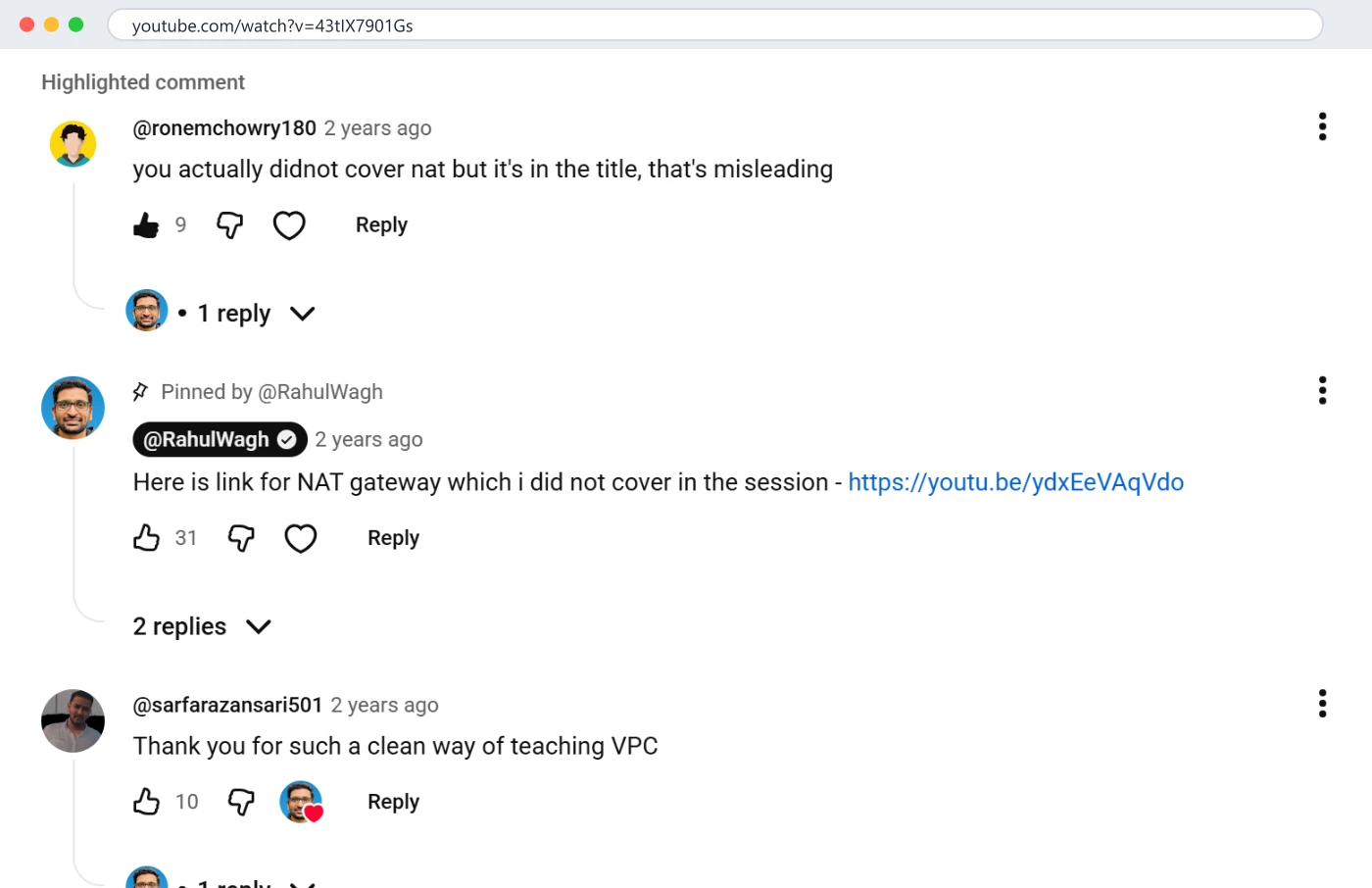
Replies become watch time on other videos. The most-liked thing in the comments of my AWS VPC video is a pinned reply with the link to the NAT gateway video I had left out of the title, 31 likes as of 13 October 2026, against 9 likes on the complaint that prompted it. Ten of my 629 replies across five videos are links to another video of mine. Each of those is a click from a viewer who just asked for exactly that video. That is watch time, and watch time is on YouTube's list.
Answered questions get read by the next viewer. From the export of 629 replies: 160 of the comments were questions and 39 were "it fails at step X" reports, and the same questions arrive for years under a tutorial. NAT gateways for private subnets came up in October 2023 and keeps coming up. When I answered it in public the follow-ups thinned out; when I did not, the same question appeared a week later. A public answer is a small FAQ on the video page, and it keeps a viewer on the page instead of leaving to search elsewhere, which again is watching behaviour, not comment counting.
Comments tell me what to make. Every long-running series on my channel has at least one video that exists because a comment asked for it; the NAT gateway video is one. This is the biggest effect comments have had on my channel's growth, and it has nothing to do with ranking signals. It is market research I did not have to run.
What the numbers do not show. I checked whether my videos with the highest reply rates are my most-viewed videos. They are not, in either direction. My most-viewed videos are the ones Google search sends people to, year after year, and their comment sections are large because the view counts are large, not the other way round. If replies drove views I would expect my most-replied videos to pull ahead over time, and they have not.
If the algorithm is not the reason, these are, and I can defend each one with something from my channel rather than a theory.
From the same export: my median reply is 21 characters, 46 percent of comments are thank-yous that take one line, and the whole job on about 200 comments a week is roughly 2.5 hours. I wrote the budget by channel size in should you reply to every YouTube comment. The point here is that the cost is small enough that the algorithm question does not need to decide it. If comments gave zero ranking benefit, I would still spend the 2.5 hours for the four reasons above.
| Comments a week | Time to answer them all, at my mix |
|---|---|
| 50 | about 45 minutes |
| 200 | about 2.5 hours |
| 500 | about 6 hours |
If you still want to know whether replies move views for you, here is a test that costs nothing and does not require believing anyone, me included.
What I expect you will find, because it is what I find: no visible difference in Suggested or Home traffic between the groups, and a small, real bump on the videos that the replies linked to. That bump is the mechanism. It is viewers clicking a link a human gave them. Call it the algorithm if you like; it is not.
Six videos is a tiny sample and a two-week window is short, so treat the result as a sanity check, not a study. But it is more evidence than any blog post telling you comments are a ranking factor has ever shown you.
I have told viewers, in videos, that replying to comments helps the algorithm. I said it because everyone said it, and because it felt true: the videos I answered comments on did well. Having now read what YouTube actually publishes and looked at my own export, I would not say it again. The videos did well because search sent them viewers, the viewers commented, and I answered. The answering was the last step, not the first.
The error is cheap when it leads to replying anyway. It is expensive when it leads to the opposite: creators who stop replying because "it does not move the needle", or who ask for comments in every video to feed a signal that YouTube does not list, or who buy a tool that posts a hundred auto-replies a day to "boost engagement" and get their channel flagged for spam. Replying is worth it for the viewer in front of you and the one behind them. That reason survives the FAQ page; the algorithm reason does not.
Not in any way YouTube has described, and not in any way I can see on my channel. Replying with a link to another of your videos increases views of that video, because the viewer asked for it and clicks. That is the mechanism, and it is a human one.
They correlate. A video with many comments usually has many views, because comments come from viewers. The arrow runs from views to comments far more than the other way.
If you will answer them, yes; a question in the video produces comments you can use. If you will not answer them, you are generating a public record of silence. Asking for comments to feed a ranking signal that YouTube does not list is the wrong reason.
There is no statement from YouTube that it does. Hearts and pins change what viewers see and feel; pin the useful comment and heart the ones you want more of.
YouTube's FAQ does not distinguish. Shorts comments are shorter, more numerous and more spam-prone, and the same logic holds: watch behaviour is the signal; comments are a conversation.
No, and they are the fastest way to turn this question into a channel strike. YouTube's spam policy covers comments posted at scale, and its API policies forbid posting without a human action. A hundred "Thanks for watching!" replies a day is not engagement; it is the pattern the spam systems are built to catch. I wrote about the policy side in automate YouTube comments: what is allowed.
There is no YouTube statement that comment sentiment is a ranking input, so removing criticism cannot help ranking and does cost you the correction. The one deletion that helps anything is removing spam links, which protects viewers, not rank.
What to do this week, no tool needed: open the comments on your three most-viewed videos, find every question that asks for a video you already have, and reply with the link. Then count the clicks on those videos next week. That is the one comment effect you can measure.
ReplyDial finds every unanswered comment across your channel, drafts a short reply in your voice, and posts only what you approve, so the buying questions and the "which video covers this" questions get answered the day they arrive. The unanswered comments checker is free and shows how many of your recent comments never got an answer.
ReplyDial lists every comment on your channel still waiting for a reply, drafts answers in your voice, and posts only what you approve. Free for 7 days on Creator limits, no card.
7 days on Creator limits, no card. Nothing is posted without your click. See the privacy policy.
How-to
Held for review on YouTube, from a real channel: what Basic and Strict hold, where held comments sit, the 60-day deadline, what the four buttons do.
17 October 2026 · 16 min read
How-to
Comments missing in YouTube Studio? Eleven causes checked on a real 104k channel in October 2026: held status, filters, sort, Viewer posts, Search, settings.
14 October 2026 · 16 min read
How-to
40 of my real YouTube replies, verbatim, from 629 answers on five videos, grouped by situation, with the numbers behind them and what broke when AI wrote them.
13 October 2026 · 21 min read