How-to
YouTube API quota for creators: why bulk comment tools break
Every comment tool gets 10,000 YouTube API units a day per project and a reply costs 50: about 200 posts a day, shared by all its users. My real numbers.
9 October 2026 · 6 min read
Blog · Creator data
Since June 2026 the YouTube API allows 100 searches a day per project plus 10,000 units for the rest. What that costs a tool, and how Discover rations it.
By Rahul Wagh·· 16 min read
Every YouTube influencer tool you have used caps your searches because YouTube does. Since Google's June 2026 change to the YouTube Data API, each project gets 100 keyword searches a day in a bucket of their own, plus 10,000 units a day for every other kind of call, where reading a channel's facts costs 1 unit and a full channel report costs about 18. Those numbers are per project, not per user, so a tool with 300 customers shares 100 live searches among all of them every day and must either pre-index channels into its own database or sell credits that map, one way or another, to those calls. The counter that says "2 searches left today" is not the vendor being stingy; it is the API ceiling showing through.
I build ReplyDial, which includes a free YouTube channel search called Discover, on that same API with the same limits, and I had the numbers wrong until I re-read Google's quota page on 3 November 2026. This post is what the quota rules say now, what they said a year ago, what one search and one report actually cost, how I ration them so a free page does not fall over at lunchtime, and the two mistakes I made along the way. If you are evaluating tools, it explains the credit systems; if you are building one, it will save you a week.
| Call, as of 3 November 2026 | API method | Cost | Daily ceiling per project |
|---|---|---|---|
| Keyword search for channels or videos | search.list | 1 call | 100 calls, own bucket |
| Upload a video | videos.insert | 1 call | 100 calls, own bucket |
| Read up to 50 channels' public facts | channels.list | 1 unit | 10,000 units shared |
| List up to 50 of a channel's uploads | playlistItems.list | 1 unit | 10,000 units shared |
| Read up to 50 videos' statistics | videos.list | 1 unit | 10,000 units shared |
| Read up to 100 comment threads | commentThreads.list | 1 unit | 10,000 units shared |
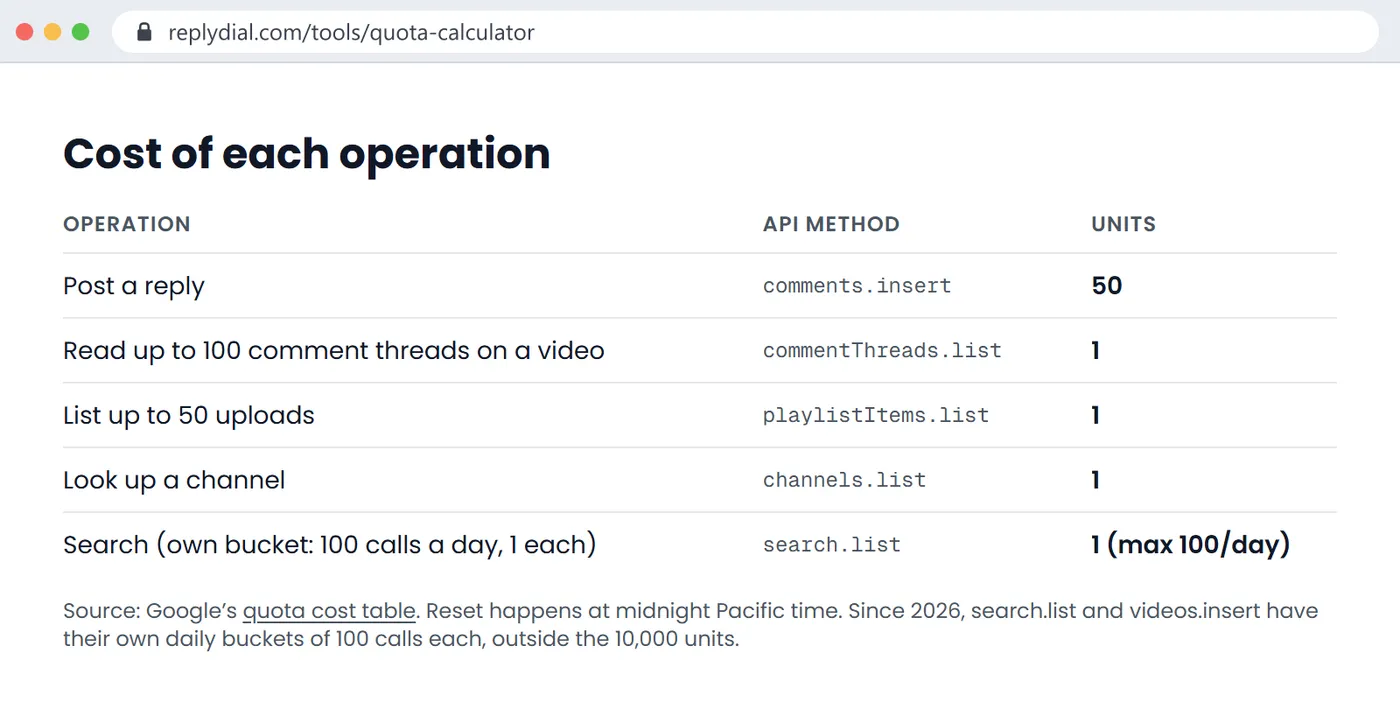
| Post a comment reply | comments.insert | 50 units | 10,000 units shared |
| A full Discover or analyzer report | about 18 units | mixed | about 550 reports a day |
Source: Google's quota cost table and getting-started page, read on 3 November 2026. Invalid requests cost a unit too, every extra page of results costs the same as the first, and all quotas reset at midnight Pacific time.
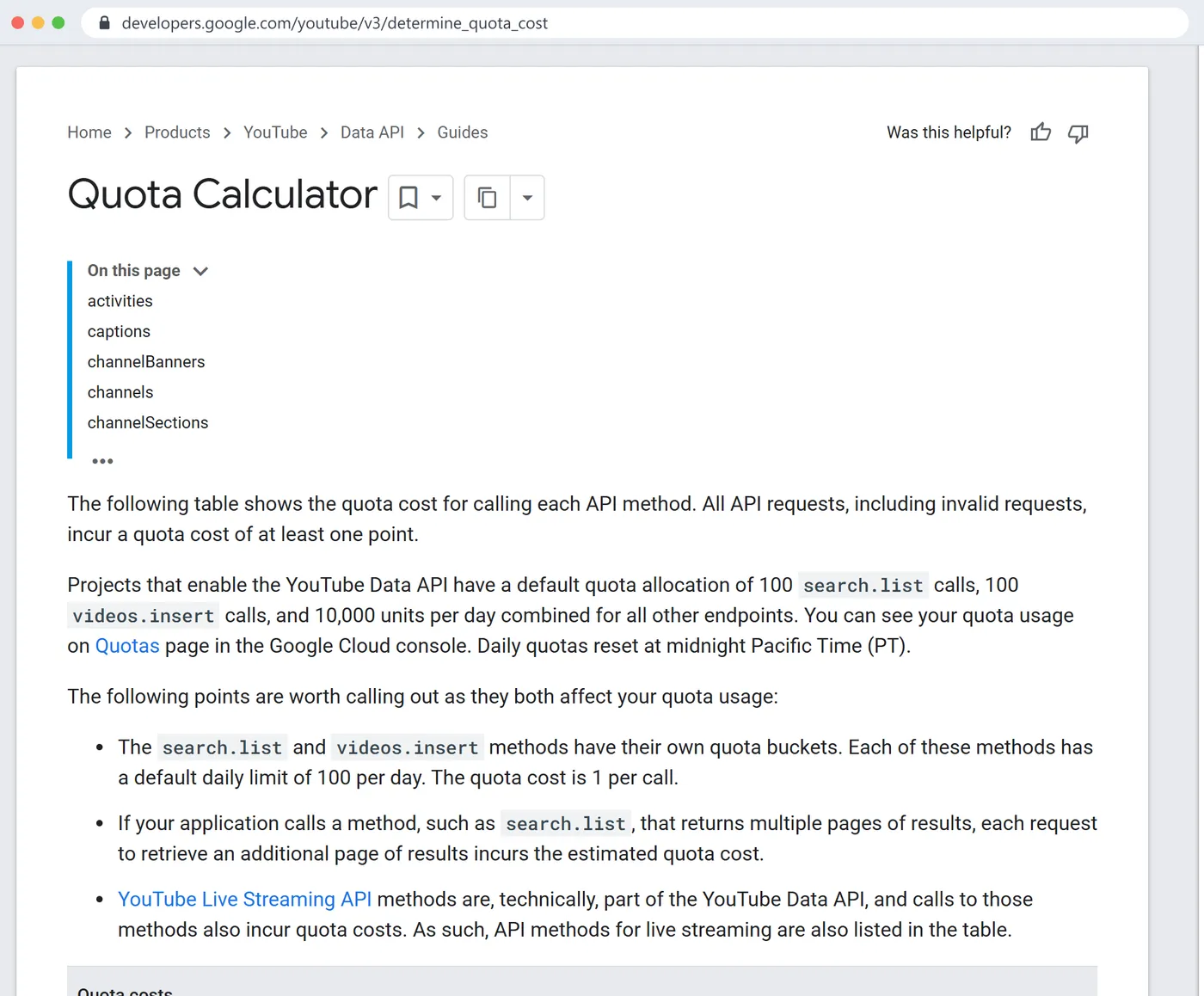
Three separate allowances, which is new. Until June 2026 there was one pool of 10,000 units a day and a keyword search cost 100 of them, so the practical ceiling was the same 100 searches, but a search competed with everything else: run 60 searches and you had 4,000 units left for reports. Google's revision history for 1 June 2026 describes the move to a "granular quota system covering smaller sets of methods", with search.list and videos.insert charged to their own buckets; the quota page now says each has a default daily limit of 100 per day at a cost of 1 per call. The December 2025 entry had already cut a video upload from about 1,600 units to about 100, which is why uploads got their own bucket too.
For a discovery tool the consequences are concrete. One hundred keyword searches a day is the hard number, and it does not grow with customers. A search returns at most 50 results per page, and each further page is another call from the same 100, so "show me 200 fitness channels" is four searches before any filtering. The search endpoint also cannot filter by subscriber count, by upload recency or by engagement; it takes words, a type (channel or video), a region code and a few ordering options. Every filter you have seen in a discovery tool is applied after the fact, to data the tool already fetched and stored.
The 10,000-unit pool is roomier but still finite. Reading a channel's public facts costs 1 unit for up to 50 channels in one call, which is cheap; reading its uploads costs 1 unit per 50 videos; reading the statistics of those videos costs 1 unit per 50; reading 100 comment threads costs 1 unit per video. The analyzer's full report on a channel, which reads its newest 300 long videos for sponsors plus the comment threads of the newest five for the audience score, lands at about 18 units. Ten thousand divided by 18 is about 550 reports a day for the whole project, before the nightly refresh of watched channels and the inventory takes its share.
Posting is the expensive side, and it is why ReplyDial's inbox product has the limits it has: a comment reply costs 50 units, so 10,000 units is 200 replies a day if the tool reads nothing at all. The quota calculator does that arithmetic for a creator's own reading pattern; I wrote the creator-side story in YouTube API quota for creators. This post is the discovery side.
The same way every one of them does, whatever the marketing says: build an index, search the index, touch YouTube only for what the index lacks. Here is what that means on Discover, with the actual numbers from the week of 3 November 2026.
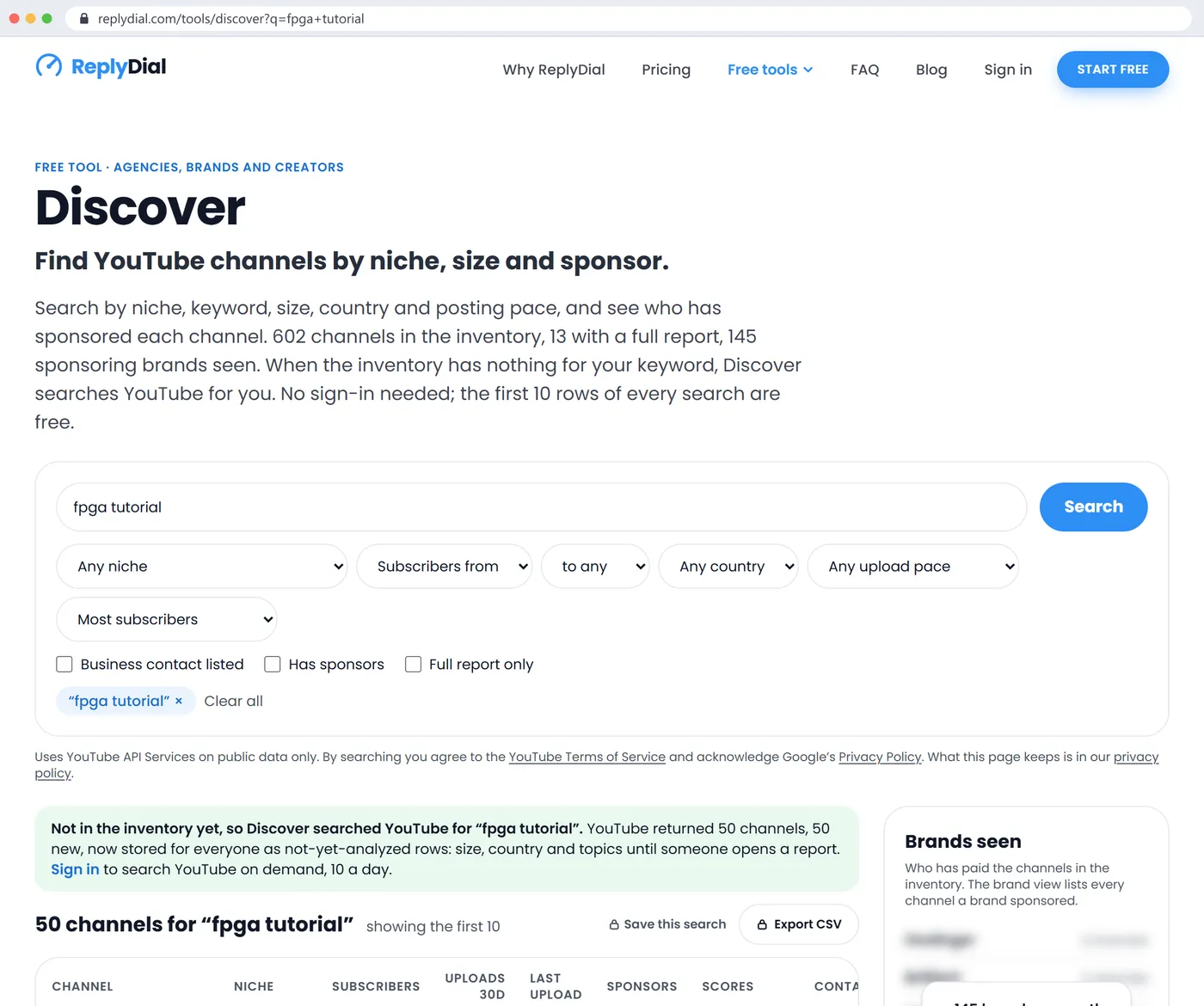
That architecture is why the honest description of any discovery tool's coverage is "the channels we have already fetched", and why the good ones tell you how many that is. Discover prints it at the top of the page: 602 channels, 13 with a full report, 145 sponsoring brands on 3 November. The paid suites print millions, because they have been fetching for years across many projects; the arithmetic underneath is the same, and so is the reason their advanced filters only work on profiles they have "opened", which is their word for spending the units.
Partly because the API makes every live action a cost, and partly because it is a convenient way to price. I read the pricing pages and help centres of the main tools on 3 November 2026, and the mechanisms rhyme with the quota table even when the vendors never mention YouTube's limits.
I am not claiming the quota explains the prices; a $12,000-a-year suite is pricing its demographics, its CRM and its sales team. I am claiming that every "profiles opened", "credits", "searches per month" and "exports per month" line you have ever been puzzled by sits on top of a meter that Google runs, and that unlimited live YouTube search does not exist at any price because nobody has it to sell. What a vendor can do is spread its 100 searches and its units across more customers by caching harder, which is also what Discover does.
Translate each limit on a pricing page into the call it stands for, and the plans become comparable. This is the table I keep for myself; the vendor figures are from their pricing and help pages on 3 November 2026.
| Pricing-page term | What it usually means in API terms | Example on 3 November 2026 |
|---|---|---|
| Search credit, search per month | One search.list call, or one page of one, sometimes one row read from an index | ChannelCrawler: 2,000 credits a month on the $59 plan, 0.1 per channel summary |
| Opened profile, profile view, analysis | The channel's facts and recent videos fetched and stored, a few units each | Modash: 300 a month on the $199 plan; Influencity: 30 analyses on its about $168 plan |
| Email reveal, contact credit | A description or About page read for a published address, then stored | ChannelCrawler: 50 on the $59 plan, 1.0 credit with email against 0.1 without |
| Tracked creator | A channel re-fetched on a schedule, so units every day | Modash: tracked slots counted per plan |
| Export, rows per export | Nothing from YouTube; a limit on reading the vendor's own index | HypeAuditor: CSV of search results only on Pro at about $499; Discover: 500 rows on the $79 Agency plan |
| Seat | Nothing from YouTube; a limit on people | Favikon: €69 a month per extra seat; Discover: none |
Two patterns fall out. First, the limits that map to YouTube calls (searches, opened profiles, tracking) are the ones every vendor must have, in some unit; the limits that do not (exports, seats) are pure pricing, and they are where the complaints concentrate in the one-star reviews: exports delivered with social links and no emails, CSV gated to the next tier, a licence per teammate. Second, the free tiers are shaped by the same meter: Heepsy's 500 results and 10 profiles, Favikon's 15 credits, HypeAuditor's one-channel free tools are all "search the index a little, fetch almost nothing". Discover's free tier is shaped the other way round, unlimited index search and a small number of fetches, because the index is what it has to give.
Around it, no; more of it, slowly. Google raises a project's defaults through a quota extension request that includes a compliance audit of the application against the YouTube API Services terms. The audit form asks what the app does with each endpoint, how it stores and refreshes data, and how it shows YouTube's branding; a passed audit can be followed by extension requests within twelve months on a shorter form. The documentation promises contact "as soon as possible" and no turnaround; developers writing about it in 2026 describe waits from a few weeks to several months and grants smaller than requested. Plan for the default.
Going around the API means scraping youtube.com, which breaks the terms of service, breaks every few weeks when the page markup changes, and is the fastest route to a project audit you did not ask for. The pay-per-result scrapers sold on automation marketplaces are cheap for a one-off list and expensive the first time a client asks where a number came from. Discover's rows are API data with a fetch date because that is the only kind I can defend.
The lever that actually works is spending fewer units per answer. A channel's uploads cost 1 unit via playlistItems.list instead of a search; fifty channel ids fit in one channels.list call for 1 unit; a report cached for a day across all servers costs 18 units once rather than once per viewer; a keyword search stored as rows means the second person who types it costs nothing. Over a week those four habits turn 100 searches and 10,000 units into a service that answers thousands of searches, which is the whole trick, and every tool you have paid for does a version of it.
Two things, one of them for a month.
I counted a search as 100 units until 3 November. Discover's code, written in October, metered a keyword search as 100 units against the shared 10,000 pool and capped the tool's YouTube searches at 3,000 units a day, which it read as 30 searches. That was Google's model until June 2026, and most articles on the web still describe it, as do the comments in my own source files until the next release. The re-read showed the real constraint: 100 search calls a day in a separate bucket, 1 each, shared by Discover's visitor searches, its paid users' on-demand searches and the nightly niche refresh. The old accounting was conservative rather than dangerous (30 is less than 100), but it meant I had been budgeting the wrong resource, and a seed job that ran 40 searches on a quiet night would have been refused for a reason that no longer existed. The fix is to count calls, not units, with the budget split between visitors, accounts and the nightly job; it ships in the next release. If you built on the API before June, your units are probably wrong too.
I made the public page before I made the fallback. The first version of the public Discover page went live on the morning of 3 November and answered a keyword the inventory did not know with an empty table and a note telling the visitor to sign in and search YouTube from the workspace. That is correct, cheap and useless: the person came with a question. The fallback that searches YouTube when the inventory has nothing was built the same afternoon, with the caps above, because the alternative to rationing is not generosity, it is a page that works until the tenth visitor and then says "quota exceeded" to everyone until midnight in California. The crawler guard came out of the same afternoon's testing, when I realised that a search URL in a sitemap is an invitation to spend 100 calls on bots before breakfast.
There is a third thing I have not done yet. Google raises the default limits through a compliance audit of the application against the API's terms of service; the form promises contact "as soon as possible", with no published turnaround, and developers describe waits from weeks to months, often with partial grants. ReplyDial has not applied yet. Until it does, the ceilings above are the ceilings, and the right response is to make the index better rather than the searches more numerous: every report anyone runs and every fallback search anyone triggers makes the next person's inventory search answer without touching YouTube at all.
The questions people ask about this, from "is the YouTube API free" to "can I scrape channels instead", are answered one by one on the Discover FAQ on data and API limits. The calls described above are the same ones in the open-source youtube-comment-tools repository, if you would rather watch the meter yourself.
This week, with no tool: open the Google Cloud console for any project that uses the YouTube Data API, find the Quotas page, and read the three numbers next to search.list, videos.insert and the shared pool. If the first one says 100 and you did not know, you now know why every tool you use has a counter. ReplyDial's Discover shows its counters on the page and searches its inventory for free at replydial.com/tools/discover.
ReplyDial lists every comment on your channel still waiting for a reply, drafts answers in your voice, and posts only what you approve. Free for 7 days on Creator limits, no card.
7 days on Creator limits, no card. Nothing is posted without your click. See the privacy policy.
How-to
Every comment tool gets 10,000 YouTube API units a day per project and a reply costs 50: about 200 posts a day, shared by all its users. My real numbers.
9 October 2026 · 6 min read
Comparisons
What ChannelCrawler, Heepsy, Modash, HypeAuditor, Upfluence and GRIN charged on 3 Nov 2026, what each tier gates, which lock you in, where $0 and $79 fit.
5 November 2026 · 17 min read
How-to
A filtered list beats YouTube search: niche, subscriber range, country and upload pace, with sponsors on each row. What 602 channels showed on 3 Nov 2026.
3 November 2026 · 17 min read